
How to Mix Dining Chairs: The Art of Creating a Curated Designer Look
Updated: Sep 8
What if the most captivating dining room you’ve ever stepped into wasn’t the one with the perfectly matched showroom set, but the one that whispered stories through its deliberate variety? Many of us feel a lingering hesitation when we consider how to mix dining chairs for the first time. There is a very real fear that without a uniform look, the heart of your home might end up looking like a disorganised jumble sale rather than a sophisticated sanctuary. You might worry about clashing heights or find yourself struggling to spot that elusive common thread that ties disparate pieces together.
It's time to embrace the creative freedom of a bespoke home. By mastering this sophisticated art, you can transform a functional space into a personal gallery that reflects your unique history and taste. This guide provides the practical guidance you need to balance scale and comfort with effortless grace. We’ll explore how to use elegant tub chairs as anchors, the way French-inspired silhouettes can soften modern lines, and how to choose a singular characteristic to unite your collection for a polished, designer finish.
Table of Contents
The Evolution of the Dining Room: Why Mixing Chairs is the Modern Standard
Finding Your Anchor: The Secret to a Harmonious Mismatched Look
Classic Meets Contemporary: Pairing Louis Style and Modern Seating
The Practicalities of Comfort: Ensuring Functionality Whilst Mixing Styles
Curating Your Collection: How to Source and Arrange Your Dining Set
The Evolution of the Dining Room: Why Mixing Chairs is the Modern Standard
The Evolution of the Dining Room reveals a fascinating journey from the communal great halls of the medieval era to the highly formalised, rigid settings of the Victorian age. In those traditional periods, a matching set was a display of wealth and order. Today, we're seeing a beautiful reversal. Mismatched dining isn't an accidental collection born of necessity; it's a deliberate design choice that prioritises character over conformity. This shift allows the British home to breathe, blending the architectural heritage of a Georgian townhouse or a rustic cottage with contemporary sensibilities.
Choosing a mixed set creates an emotional impact that a uniform suite often lacks. It feels less like a "showroom-perfect" display and more like a lived-in sanctuary. When a room isn't tied to a single manufacturer's catalogue, it feels approachable and warm. It tells your guests that your home is a place for conversation and comfort, rather than a stiff museum of furniture. This trend is particularly suited to the UK, where we often find ourselves needing to bridge the gap between historic features and modern life.
The Death of the Dining "Set"
Buying "six of the same" can sometimes feel sterile in a modern home. It risks turning a vibrant living space into something that resembles a corporate meeting room. High-end interior design has moved decisively toward the "collected" look, where every piece feels like it was chosen with love over time. We define the curated dining aesthetic as a purposeful balance of variety and intent. It’s about understanding how to mix dining chairs so the room feels cohesive without being carbon-copied. A mixed set invites guests to choose the seat that speaks to them, breaking down the formality of traditional hosting.
Telling Your Story Through Seating
Your home is an extension of your identity. A curated set lets you incorporate a cherished family heirloom alongside new luxury purchases, such as velvet-clad tub chairs or refined Louis style chairs. This layering of eras and textures creates a narrative that a flat, matching set simply cannot achieve. You should view your dining room as an evolving gallery of your favourite styles. Perhaps you start with a pair of elegant occasional chairs at the head of the table and introduce different textures along the sides, or even incorporate unique paintings from Brian Crosby Art to enhance the room's narrative. This approach ensures your space remains a reflection of your personal history, where every piece has a reason for being there.
Finding Your Anchor: The Secret to a Harmonious Mismatched Look
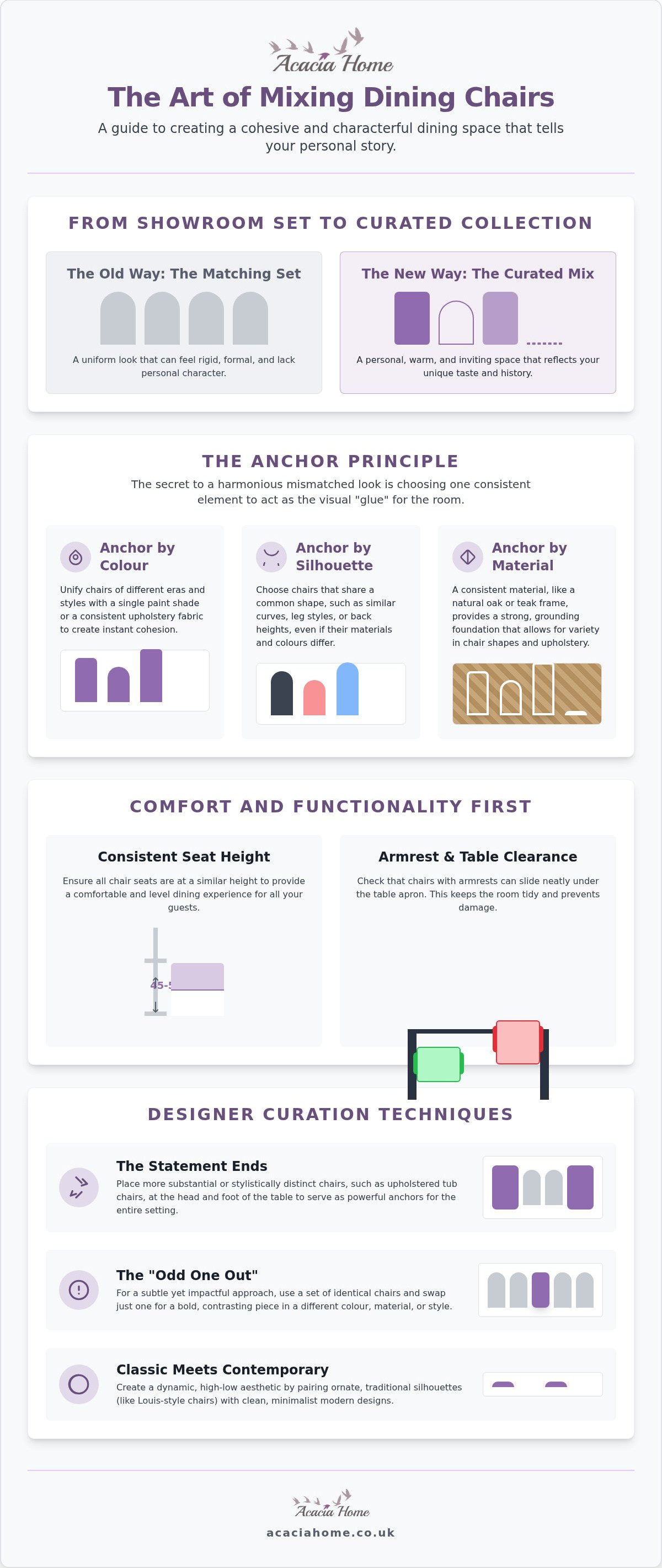
Successful curation begins with a single, unwavering rule: the Anchor Principle. This approach suggests that whilst you can play with variety, you must choose one consistent element to act as the visual glue for the room. When you understand how to mix dining chairs, you realise that the eye needs a place to rest amongst the diversity. An anchor provides that necessary point of reference, ensuring your collection feels like a deliberate gallery rather than a random assortment of furniture.
Consider the three primary anchors: colour, silhouette, and material. A shared colour palette is perhaps the most forgiving method. You can gather a collection of antique finds, mid-century pieces, and modern silhouettes, then unify them through a single paint shade or upholstery tone. Alternatively, silhouette anchoring involves choosing chairs with shared curves or angles, such as the elegant lines of French regency style, but finishing them in a kaleidoscope of different fabrics. Material anchoring works similarly; using all-oak or all-teak frames provides a sturdy foundation that allows for a mix of heights and back styles.
Anchoring by Colour and Fabric
Shared textures, such as a rich velvet, can bridge the gap between wildly different chair frames. If you have a set of varied timber chairs, ensuring they all share a consistent wood finish, like a soft natural oak, grounds the look instantly. This consistency allows the individual craftsmanship of each piece to shine without creating visual noise. It’s about finding that one "hero" element that speaks across every seat at the table.
For those who prefer a subtler approach, the "Odd One Out" technique is highly effective. This involves using five matching chairs and introducing one bold, contrasting statement piece to break the monotony. It’s an excellent way to showcase a particularly beautiful occasional chair or a family heirloom without committing to a full set of mismatched pieces. This single point of difference creates a focal point that feels sophisticated and intentional.
Symmetry and the Power of Pairs
Pairing chairs in twos introduces a sense of architectural order. This structure is a brilliant way to approach how to mix dining chairs if you are nervous about the room looking too chaotic. By grouping identical pairs opposite each other, you create a mirror effect that satisfies our natural desire for symmetry. This rhythmic flow feels designer-led and ensures the space remains balanced, regardless of how diverse the individual pairs might be.
A classic "Head of the Table" strategy involves placing larger, more commanding tub chairs at the ends of the table. These pieces act as sturdy anchors for the entire set, allowing you to be more adventurous with the side chairs. It’s a wonderful way to introduce a sense of hierarchy and superior comfort to your dining sanctuary, making every meal feel like a special occasion. Using these more substantial seats at the ends provides a visual "stop" to the table, framing the collection perfectly.
Classic Meets Contemporary: Pairing Louis Style and Modern Seating
Mastering the "High-Low" mix is perhaps the most rewarding challenge when discovering how to mix dining chairs. This design philosophy pairs ornate, heritage-inspired silhouettes with the crisp, clean lines of modern furniture. It creates a delightful visual tension that stops a room from feeling too one-dimensional. By introducing Louis style chairs into a contemporary setting, you ground the space with a sense of history whilst keeping the overall vibe fresh and relevant.
One of the most effective ways to execute this look is through wood-on-wood mixing. Don't feel restricted to a single timber tone. Pairing the deep, rich hues of a mahogany-finished heritage chair with a lighter, contemporary oak or ash table can be incredibly striking. This contrast highlights the craftsmanship of both pieces, allowing the traditional carving to stand out against the minimalist backdrop of the modern table.
The Elegance of the Louis Silhouette
Louis XVI chairs are particularly versatile for a mixed set because of their refined geometric shapes. Their iconic oval or rectangular backs provide a beautiful contrast to the sharp edges of a modern rectangular table or the soft curves of a glass pedestal design. This interplay of shapes is a sophisticated way to approach how to mix dining chairs without relying solely on colour. You might choose to pair a set of carved wooden frames with a table that features industrial metal legs or a sleek glass top, bridging the gap between centuries of design with effortless grace.
Balancing Visual Weight
When you're blending different eras, you must consider the "visual weight" of each piece. French-style furniture often carries more presence due to its upholstery and detailed woodwork, so it's vital to distribute these pieces thoughtfully. Avoid clustering all the substantial, "heavy" chairs on one side of the table, as this can make the room feel lopsided. Instead, intersperse them with lighter, more minimalist frames to maintain a sense of equilibrium. The intricate details of a French chair can act as a room’s primary focal point, drawing the eye whilst the surrounding modern pieces provide a quiet, supporting role.
If you're working with a smaller dining sanctuary, consider these strategies to maintain an airy feel:
Use transparent elements: Mix in "ghost" variations of classic silhouettes to provide the shape of a heritage chair without the visual bulk.
Alternate heights: Place your taller Louis chairs at the ends of the table and use lower-profile modern benches or stools along the sides.
Limit the palette: Keep the upholstery colours consistent across both the old and new styles to unify the varying visual weights.
The Practicalities of Comfort: Ensuring Functionality Whilst Mixing Styles
Whilst the visual appeal of a curated set is undeniable, the true success of learning how to mix dining chairs lies in the unseen details of ergonomics and comfort. A dining room is, after all, a place for long, lingering conversations and shared meals. If the seating doesn't support the body as well as it pleases the eye, the designer look remains a hollow victory. Your home should be a sanctuary of ease, where every guest feels equally invited to stay a little longer.
The Golden Rule of Seat Height remains the most critical factor for a harmonious experience. A range of 45-50cm from the floor to the seat is non-negotiable. Even if your chair backs vary wildly in height, keeping the seat levels consistent ensures that no one at the table feels like they're sitting in a high chair or sinking into a lounge. Similarly, consider the "Shoulder Line" principle. Whilst back heights can differ, keeping them within 10-15cm of each other creates a cleaner, more intentional horizon that prevents the room from feeling chaotic.
Managing armrest clearance is equally vital for a functional space. If you’ve chosen luxury dining chairs with elegant carver arms, you must ensure they tuck neatly under the table apron. There's nothing more frustrating than a chair that sticks out into the room, blocking walkways and disrupting the flow of the home. Always measure the distance from the floor to the underside of your table before committing to a new piece.
The Ergonomics of the Mix
Measure your table height before you begin sourcing. Standard UK dining tables sit around 75cm high, which leaves about 25-30cm of legroom when paired with the 45-50cm seat height rule. Seat depth matters just as much as height, especially if your guests vary in size. Ensure the "pitch" or lean of each chair is relatively similar. If one person is bolt upright whilst another is in a relaxed recline, the natural flow of eye contact and conversation becomes awkward and strained.
Maintenance and Longevity
Mixing different materials like cane, leather, and velvet adds a rich sensory layer to your sanctuary, but it also introduces varying care requirements. High-quality frames are essential when pieces are moved and used daily. Well-crafted occasional chairs often make excellent additions to a dining setting because they're built with a level of durability and detail that stands up to frequent use. To ensure your curated set lasts for years, browse our range of expertly selected seating designed to balance heritage craftsmanship with modern durability.
To keep the set looking polished, provide enough "elbow room" for each guest. Aim for a width of 60cm to 75cm per person. This spacing allows the individual silhouettes of your mixed chairs to be appreciated as separate works of art rather than being squashed into a cluttered line.
Curating Your Collection: How to Source and Arrange Your Dining Set
Building a curated dining set shouldn't feel like an endless scavenger hunt. Whilst some suggest finding one perfect antique at a time, this unpredictable approach often leads to a disjointed room that lacks a central vision. A more intentional way to master how to mix dining chairs is to source from a specialist curator who understands the delicate balance between heritage and modern life. This allows you to create a "polished casual" register where every piece feels part of a larger, cohesive story rather than a lucky, accidental find.
The debate between symmetry and chaos is easily settled by the designer’s eye. Symmetry provides the architectural order our brains crave, whilst a touch of variety offers the character that makes a house a home. By following the anchor principles discussed earlier, you can ensure your arrangement feels like a deliberate gallery. Start your journey with a few foundational pieces from a trusted source, allowing your collection to grow with intent and grace.
Sourcing with a Designer’s Eye
When selecting premium pieces to anchor your dining space, you can learn more about Al Hammad International trd and their range of high-quality furniture solutions for residential environments.
When searching for new additions, look for "families" of chairs. These are pieces that might have different silhouettes but share the same leg style, wood finish, or upholstery texture. Buying from a specialist like Acacia Home ensures that even disparate styles share a common thread of quality and craftsmanship. This expert curation does the heavy lifting for you, providing a selection that is already designed to sit harmoniously within a sophisticated British interior.
One of the most effective sourcing strategies is to invest in two high-quality "end" chairs. Placing a pair of commanding, upholstered seats at the head and foot of the table instantly elevates simpler chairs along the sides. These "anchor" pieces set the tone for the entire room, allowing you to be more adventurous with the remaining seats. This hierarchy creates a focal point that signals a professionally designed space, even if the side chairs are a mix of heritage heirlooms and modern finds.
Final Touches for a Cohesive Look
Once you have gathered your pieces, use a large area rug to ground the entire set. A rug acts as a visual frame, pulling the different colours and textures of your chairs into one unified palette. It provides a boundary that contains the variety, preventing the mismatched look from spilling over into "cluttered" territory. Similarly, a central pendant light hanging low over the table draws the eye upward, unifying the table and chairs under a single glow.
If you still find certain chairs feel a little too disparate, consider using cushions or seat pads to bridge the gap. Choosing a consistent fabric or a shared colour story for these soft additions can unify even the most different silhouettes. We invite you to explore our full range of occasional and dining chairs to find those perfect foundational pieces that will act as the heart of your curated sanctuary. With the right anchors in place, the art of how to mix dining chairs becomes an effortless expression of your personal style.
Crafting Your Curated Dining Sanctuary
Transforming your dining room into a characterful sanctuary is a journey of deliberate curation. By mastering the art of how to mix dining chairs, you move beyond the sterile predictability of matching sets and embrace a home that tells your personal story. Remember that the most successful spaces are anchored by a shared element, whether it's a consistent colour palette, a specific wood finish, or the elegant silhouette of a heritage frame. Whilst you play with variety, maintaining a consistent seat height ensures your space remains as functional as it is beautiful.
At Acacia Home, we bring family-owned expertise to help you bridge the gap between global craftsmanship and British style. Our refined selection of French-inspired and contemporary seating is designed to act as the perfect foundation for your bespoke set. Whether you're looking for a pair of statement tub chairs to anchor the table ends or a refined set of Louis style chairs to soften modern lines, we provide national UK delivery on all our seating to bring your vision to life. Discover our curated collection of luxury dining and Louis style chairs to start your mix. Your dream dining space is just a few thoughtful selections away.
Frequently Asked Questions
Can I mix chairs of different heights?
Yes, you can absolutely mix chairs with different back heights to create a dynamic silhouette. The crucial factor is keeping the seat heights uniform so guests remain at the same eye level whilst dining. Whilst backrests can vary, keeping them within a 10-15cm range of each other prevents the "Shoulder Line" from looking too erratic. This approach adds architectural interest to your home sanctuary without compromising the social flow of the meal.
How many different styles of chairs should I have around one table?
For a balanced look, we recommend starting with two or three distinct styles. You might choose a pair of substantial tub chairs for the ends and four matching side chairs. If you’re feeling more adventurous about how to mix dining chairs, you can introduce more variety as long as you maintain a shared anchor, such as a consistent colour or wood finish. This ensures the collection feels like a curated gallery rather than a random assembly.
Is it okay to mix different wood types in a dining set?
Mixing wood types is a wonderful way to add depth and heritage to your dining space. You can pair a dark mahogany Louis style chair with a lighter oak or teak table for a striking "high-low" contrast. The key is to ensure the undertones are compatible. For instance, pairing warm-toned woods together creates a harmonious feel, whilst mixing cool and warm tones can provide a more contemporary, eclectic edge to your seating arrangement.
What is the best way to mix modern and antique chairs?
The most effective strategy is to use one style as a focal point and the other as a supporting element. Pairing ornate, French-style silhouettes with a minimalist glass or metal table creates a sophisticated visual tension. This juxtaposition allows the craftsmanship of the antique-style piece to shine without making the room feel dated. It’s about celebrating global-to-local connections by blending traditional craftsmanship with the clean lines of modern British interiors.
Should all the chairs have the same upholstery?
Whilst using the same upholstery is an excellent way to unify disparate frames, it isn't a requirement. You can mix fabrics like velvet, leather, and linen to introduce rich sensory textures to your dining room. If you choose different fabrics, try to stay within a cohesive colour palette or use shared seat pads to create a visual link. This subtle repetition helps the eye navigate the variety without feeling overwhelmed by clashing patterns or tones.
What is the ideal seat height for a dining chair?
The standard seat height for a comfortable dining experience is between 45cm and 50cm. This measurement ensures that most adults have enough legroom beneath a standard 75cm high table whilst maintaining a proper posture for dining. When you are learning how to mix dining chairs, always measure from the floor to the top of the seat cushion to ensure every piece in your collection offers a consistent level of comfort for your guests.
How do I stop my mismatched chairs from looking like a mess?
Adhering to the "Anchor Principle" is the best way to prevent a jumbled appearance. Choose one consistent element, such as a shared wood finish, a single upholstery colour, or a similar leg style, to tie the collection together. This deliberate repetition provides a sense of order amongst the variety. Using a large area rug to ground the set also helps to define the dining area and pull the disparate pieces into a unified, designer-led composition.
Can I use occasional chairs as dining chairs?
Yes, occasional chairs are often the perfect choice for the head and foot of a table. These pieces are typically more substantial and offer a higher level of comfort, making them excellent anchors for a mixed set. Ensure the seat height aligns with your other chairs and that any armrests clear the underside of the table. Using these more decorative pieces adds a bespoke, characterful touch that reflects your personal history and sophisticated taste.
Comments