
Chaise Longue for Living Room Ideas: 5 Ways to Create a Beautiful, Relaxed Space
What if the best place for a chaise longue isn’t tucked into an empty corner, but where it naturally supports the way you use your living room? If you’re looking for chaise longue for living room ideas, you may worry that this generous seat will crowd the space or look like an oversized extra chair. The right position depends on the room’s shape, its focal point and the routes people need to move through it.
A chaise longue can become a reading retreat, a place to stretch out or part of a conversation area, provided it fits into everyday life. This guide covers five practical layouts, with advice on placement, proportion and keeping walkways clear. You’ll also find ways to relate the chaise to the furniture and décor you already have, whether you choose a standalone piece or a chaise section within a sofa. A few considered choices can help it feel like a natural part of the room.
Table of Contents
Chaise Longue for Living Room Ideas: Start with the Room's Shape and Purpose
A chaise longue offers an inviting place to pause, stretch out or settle in with a book. Finding a place for it in an established living room can be less straightforward, especially when the sofa, tables and favourite belongings already have their spots. Start with how the room works, rather than trying to recreate an idealised layout. The most useful chaise longue for living room ideas respond to your routines and the space you actually have.
Choose a living-room role before choosing a position
A reading spot near a window is one possibility, but it isn’t the only role a chaise can play. It can complement the main sofa, offering another way to relax, or help shape a more informal conversation area. Notice where people naturally sit, where they put down a book or cup, and which routes they take across the room. These everyday habits can show what the new seat should make easier.
Read the room's shape, focal point and existing layout
Look at the room’s natural anchors before deciding where the chaise belongs. A window may suggest a spot to enjoy the light, while a fireplace or television may already draw the main seating towards one wall. Consider the entrance, too: placing a chaise across the natural route into the room can make the whole arrangement feel awkward. The chaise longue has a distinctive form and history, but its best modern position depends on how it fits your room, not on a universal layout rule.
In a long, narrow room, placing the chaise alongside the sofa may preserve a clearer route through the space. In a broader room, it could sit at an angle to define a reading nook while still facing the room’s focal point. Check how other furniture, such as a side table, footstool or occasional chair, affects the available space before settling on a position. If floor space is limited, compare the chaise’s listed dimensions with the area you have measured.
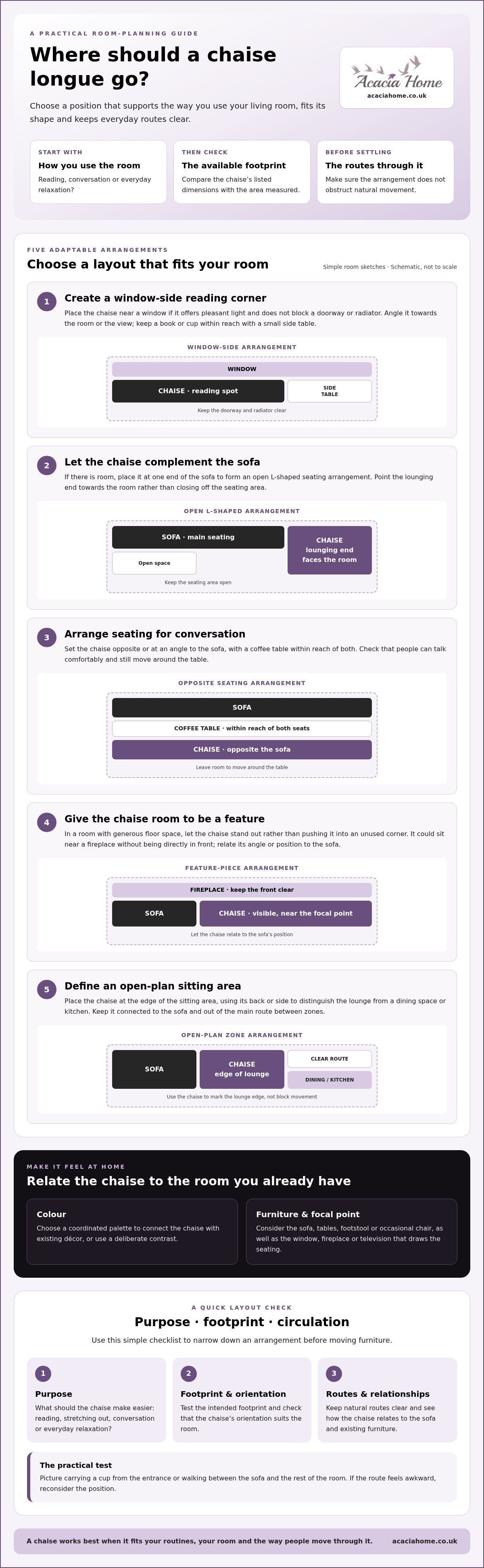
Start with three checks: purpose, footprint and circulation. Decide what the chaise should help you do, work out how much space it can occupy, then check that people can move comfortably around it. These checks give you a practical basis for comparing different arrangements.
Five Chaise Longue Layout Ideas for Different Living Rooms
These chaise longue for living room ideas are starting points, not strict templates. Test each against your room’s shape, existing furniture and daily routines. An arrangement that works in an open space may feel cramped in a narrower room.
1. Create a window-side reading corner
If a window offers pleasant light without blocking a doorway or radiator, position the chaise nearby and angle it towards the room or view. A small side table can keep a book or cup within reach, while a reading light is useful after daylight fades. The chaise doesn’t have to sit directly against the window or serve as a window seat.
2. Let the chaise complement the sofa
If there’s room beside the main sofa, place the chaise at one end to create an open L-shaped arrangement. Point its lounging end towards the room, rather than closing off the seating area. This gives people another comfortable place to settle while leaving the sofa as the main spot for shared viewing or conversation.
3. Arrange seating for conversation
For a sociable layout, set the chaise opposite or at an angle to the sofa, with a coffee table within reach of both seats. The angled grouping can feel more welcoming than a row of seats facing in one direction. Check that people can talk comfortably across the space and still move around the table.
4. Give the chaise room to be a feature
If the living room has generous floor space, let the chaise stand out instead of pushing it into an unused corner. Position it where its shape can be appreciated, perhaps near a focal point such as a fireplace without placing it directly in front. Relate it to the sofa through its angle or position so the arrangement feels considered.
5. Define an open-plan sitting area
In an open-plan room, place the chaise at the edge of the sitting area, using its back or side to distinguish the lounge from a dining space or kitchen. Keep it connected to the sofa, perhaps facing inwards, and avoid placing it across the main route between zones. This can suggest a separate place to relax without closing off the room.
A good chaise longue layout preserves comfortable routes through the room. Before settling on an idea, imagine carrying a cup from the entrance or walking between the sofa and the rest of the space. To compare seating options, explore Acacia Home’s indoor furniture alongside your preferred layout.
Make a Chaise Longue Feel at Home with the Sofa, Colours and Textures
A chaise longue can blend quietly with the room or bring a welcome contrast. Either approach can feel considered; the key is to relate the new seat to something already in the room, rather than matching every detail. As you explore chaise longue for living room ideas, consider your sofa’s colour, visual weight and shape. A substantial sofa may sit well with a chaise of similar presence, while a simpler sofa can leave room for a more distinctive design.
Use this comparison to decide which direction suits your space:
Coordinate the chaise longue with your sofa without matching everything
Matching every colour and shape can make a seating area feel overly uniform, while too many unrelated elements can compete for attention. Look instead for one or two points of connection: a shared colour, a similar curve or a repeated texture elsewhere in the room. Consider the sofa’s proportions as well as its appearance, so the chaise feels balanced beside it rather than overpowering it.
Styling principle: repeat one detail from a statement chaise elsewhere in the room to help it feel connected.
Use lighting and accessories to complete the seating area
A floor lamp beside the chaise or a table lamp on a nearby surface can make a reading spot inviting as the light changes through the day. A side table gives you a practical place for a book or cup; a cushion can add colour or softness. Choose accessories with a purpose and leave enough space for the chaise to remain the focus.
For a calm look, repeat a colour in a nearby accessory. For a livelier contrast, choose a detail that picks up an accent already in the room. Explore Acacia Home’s indoor furniture to see seating and occasional furniture that could work with your arrangement.
Check Proportion, Orientation and Walkways Before You Settle on a Layout
A chaise longue can look at home in a room plan yet feel cumbersome once it’s in place. Before committing to one of your favourite chaise longue for living room ideas, test the fit in the room itself. Measuring first can help you spot awkward turns, blocked access or a layout that leaves too little space around the other furniture.
Measure the footprint and test the chaise longue's orientation
Check the chaise longue’s listed dimensions, including its overall width and depth. Compare these with the floor area you have in mind, allowing for nearby furniture and the space needed to approach and use the seat. Don’t measure only an empty corner; consider how the chaise will relate to the sofa, tables and walls around it.
Next, confirm which side or end suits the proposed position. Left- and right-facing descriptions can depend on the specific piece, so check the product information and make sure the lounging end will point where you expect. A simple room sketch can show the chaise beside the sofa and the direction its extended seat will face.
Use a temporary floor outline to visualise the chaise longue’s footprint before rearranging. Removable tape, or another temporary marker suitable for your flooring, can help trace the intended width and depth. Stand back to assess the overall balance, then sit in the space or mimic how you would use it.
Keep everyday movement and other furniture in mind
Walk through the proposed arrangement as you would during an ordinary day. Try the route from the entrance to the sofa, and from the sofa to the window or other frequently used areas. Notice whether the chaise creates a pinch point, interrupts access to another seat or makes it awkward to reach a table.
Check nearby doors and drawers, too. A door needs room to open, and drawers should remain usable without moving a chair. Keep windows accessible if you need to open them, and make sure the chaise doesn’t obstruct the route between the main seating and the rest of the room. These practical checks help an attractive arrangement work comfortably in daily life.
If you’re weighing up what kind of additional seat best suits your room, compare the chaise’s lounging role with the more upright use of an occasional chair. Once the footprint and orientation feel right, explore chaise longues at Acacia Home as you consider options for your living-room arrangement.
Bring Your Favourite Chaise Longue Living Room Idea Together
A successful arrangement balances what you want the chaise longue to do, how it relates to the other seating, whether its colours and shapes suit the room, and how easily people can move around it. An inspiration image can spark an idea, but it’s a starting point, not a rule. Adapt what appeals to your room’s proportions and the routines of the people who use it.
Use this quick checklist to refine your preferred arrangement
Before moving furniture or exploring chaise longue options, check the details that will make the layout work day to day:
Purpose: Does the chaise support an activity, such as relaxing or reading, and complement the seating you already use?
Position and fit: Have you checked its footprint and orientation against the available space?
Movement: Can people still use the usual routes through the room and reach doors, windows and nearby furniture?
Style: Would you rather echo the existing palette or introduce a considered contrast? Could a colour, texture or shape be repeated elsewhere to connect the look?
If one answer gives you pause, adjust the plan before settling on a position. Turning the chaise, shifting another seat or choosing a different spot may make the room feel more open without losing the relaxed quality you want.
Explore chaise longues as part of a considered living room
Acacia Home offers chaise longues and window seats alongside a wider selection of indoor seating and furniture. As you compare options, keep your measurements and preferred layout in mind, and check each piece’s listed dimensions and orientation rather than relying on an inspiration image alone.
There’s no single arrangement every living room needs to follow. A good fit, a clear purpose and a detail that ties the chaise into your existing décor can make it feel like a natural part of the space. When you’re ready, browse Acacia Home’s indoor furniture for seating to consider as you plan your room.
Create a Living Room That Feels Relaxed and Considered
The best chaise longue for living room ideas start with how you use the space, then make room for comfort without compromising its flow. Choose a position that works with the room’s focal point and existing seating, check the footprint and orientation, and keep everyday routes clear. To connect the chaise to your décor, echo a colour, texture or shape elsewhere, or introduce a deliberate contrast that suits the room.
Let inspiration guide you, not dictate the layout. A small change to the position or surrounding furniture can help an idea feel right for your home and routines. Acacia Home offers chaise longues and window seats alongside a wider range of indoor seating and occasional furniture. Explore Acacia Home’s indoor furniture and find a chaise longue to consider for your preferred arrangement.
Frequently Asked Questions
Where should I place a chaise longue in my living room?
Place a chaise longue where it supports how you use the room without interrupting everyday movement. You might position it near a window for a quiet retreat, beside a sofa to extend the seating, or at an angle to encourage conversation. Consider the focal point, entrance and existing furniture, then test the proposed spot with a temporary floor outline. The best position is one that feels comfortable and leaves clear routes around it.
Can a chaise longue work in a small living room?
Yes, a chaise longue can work in a small living room if its footprint suits the available space. Measure the intended area and compare it with the piece’s listed dimensions, including its full depth. Mark the outline on the floor and check that doors, drawers and walkways remain accessible. In a compact room, placing the chaise alongside existing seating may work better than putting it where it narrows the main route.
How do I arrange a chaise longue with a sofa?
Arrange the chaise longue to complement the sofa while keeping the seating area easy to use. Placing it at one end of the sofa can create an open L-shaped grouping, while setting it opposite or at an angle can encourage conversation. Consider the size and shape of both pieces, and leave room to reach the coffee table and move between seats. Try the layout with a floor outline before shifting heavier furniture.
Should a chaise longue face left or right?
Choose the orientation that fits your intended position and the way you want to use the chaise. Left- and right-facing descriptions can vary between individual pieces, so check the product details rather than relying on the label alone. Picture where the extended lounging end will sit in relation to the sofa, wall and walkway. A simple room sketch can help you confirm the direction before making a decision.
How can I make a chaise longue look cosy in a living room?
Make a chaise longue feel cosy by giving it a clear purpose and a few thoughtful finishing touches. A nearby lamp can make it more inviting for reading, while a side table keeps a book or cup close to hand. Add a cushion if it suits the seat, and connect the chaise to the rest of the room by repeating a colour, texture or shape elsewhere. Keep accessories balanced so the chaise remains the focus.
Can I put a chaise longue in front of a window?
You can place a chaise longue near a window if there’s enough room and it doesn’t block access or make the space awkward to use. Before positioning it directly in front, check whether you can still reach the window, open it as needed and move around the seat comfortably. A nearby spot or slight angle may preserve the light and view while keeping the room’s usual routes clear.
What should I check before buying a chaise longue for my living room?
Before buying, check the chaise longue’s listed dimensions and compare its full footprint with the space you have measured. Confirm which side the lounging end faces, then consider how it will sit beside your sofa and other furniture. Use removable tape to mark the outline and walk the routes you use every day. Think about whether the chaise suits your household’s activities and how its colour or shape will relate to your décor.


Comments