
Chaise Longue for Bay Window: How to Choose the Right Fit in 2026
What if the best chaise longue for bay window isn’t the one that follows the window’s shape most closely? A beautiful bay can make an inviting reading nook, but the floor space around it, the room’s walkways and the chaise’s orientation matter just as much as the window itself.
If you’re unsure how to measure angled or curved sides, or worry that a chaise might dominate the room, you’re not alone. Product photos can make it tricky to judge scale, comfort and which end will sit best beside the bay. A little planning before you browse can help you find a piece that feels right in the room, not just on screen.
This guide will help you measure the usable space, think through clearance and choose a shape and position that suit both the bay and the wider layout. We’ll also look at comfort, intended use and style, so you can create a welcoming place to unwind without blocking the flow of the room. Whether you’re considering a chaise longue or a window seat, the aim is the same: a considered, comfortable corner that feels at home in your interior.
Table of Contents
Is a chaise longue right for your bay window?
A bay can become one of the most inviting corners of a room, offering a natural spot to pause, read or simply enjoy the changing light. A chaise longue can give this underused area a more considered purpose, but the window’s shape alone won’t tell you whether one will fit. The key is the usable floor space around it, including room to move past comfortably.
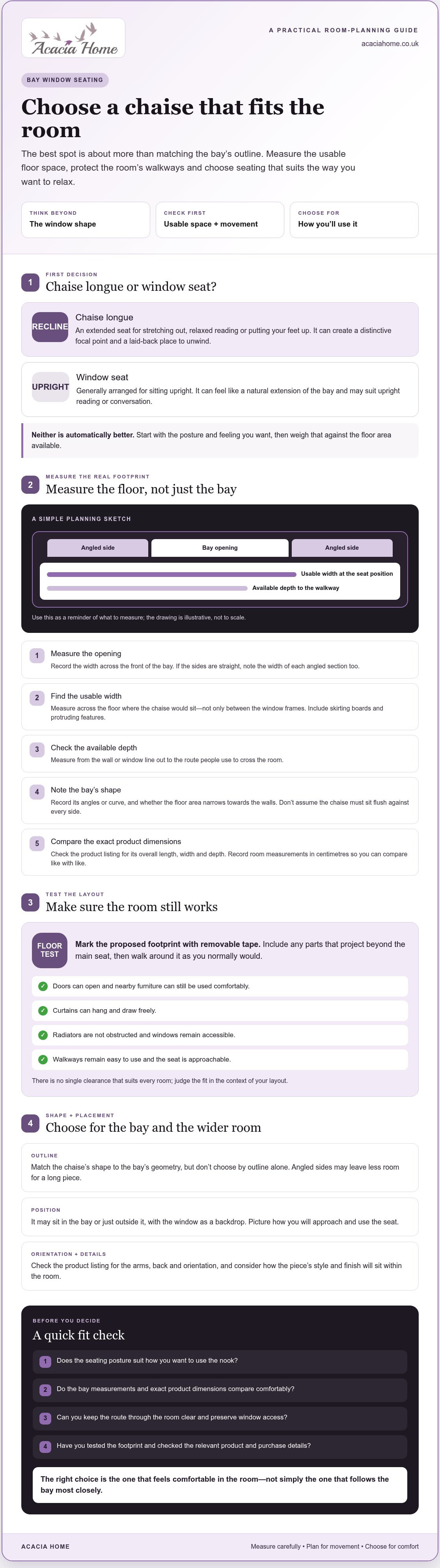
A chaise longue has an extended seat designed to support a reclined position. In simple terms, a chaise longue is a lounging seat with room to stretch out, whilst a window seat is generally arranged for sitting upright. That difference affects how you’ll use the space as well as how the furniture feels within it.
What makes a chaise longue different from a window seat?
The long seat of a chaise suits relaxed reading or putting your feet up, creating a more laid-back place to unwind than a conventional window seat. A window seat is typically designed around a more upright posture and can feel like a natural extension of the bay. Neither is automatically the better choice: consider whether you want to recline or sit upright, then weigh that preference against the floor area available.
When does a chaise longue work well in a bay?
A chaise can work beautifully if you want a quiet reading spot, a place for a short rest or a distinctive focal point by the window. Daylight and a view can make the nook feel especially welcoming, whilst the chaise adds a comfortable, inviting shape to the room. Its position still needs to make sense in practice: curtains must hang freely, radiators shouldn’t be obstructed, and walkways should remain easy to use.
Before settling on a chaise longue for bay window placement, picture how you’ll approach and use the seat, not just how it will look against the glass. Some bays offer a generous central area; others have angled sides that leave less room for a long piece of furniture. You may find the chaise works best in the bay itself, or just outside it, with the window as a backdrop. Either way, judge the fit by the space the furniture occupies and the movement the room needs.
If you’re choosing between a chaise and a window seat, start with the feeling you want the corner to offer. A chaise brings a more relaxed, reclining posture; a window seat can make upright reading or conversation feel more natural. The right choice is the one that suits your habits and sits comfortably within the room, rather than the one that simply follows the bay’s outline.
How to measure a bay window before choosing a chaise longue
A bay’s outline can be deceptive: the window may look spacious, yet the floor area in front of it may be limited by a walkway, radiator or nearby furniture. Measure the place where you might actually position the chaise, rather than relying on the window’s width alone. Record each measurement in centimetres and note where you took it, so you can compare like with like when browsing.
Which measurements matter in a bay window?
Work through these steps before choosing a chaise longue for bay window placement:
1. Measure the opening. Record the width across the bay at the front, and note the width of each angled section if it has straight sides.
2. Find the usable width. Measure across the floor at the intended chaise position, not just between the window frames. Include skirting boards and any protruding features that could affect where the furniture sits.
3. Check the available depth. Measure from the wall or window line out to the route people use to cross the room. This shows how far a chaise can extend without making the space awkward to pass through.
4. Record the shape. Note the bay’s angles or curve, and whether the floor area narrows towards the walls. This helps you picture possible positions without assuming the chaise must sit flush against every side.
5. Measure the product. Compare your notes with the exact dimensions on the product listing, including its overall length, width and depth.
Check both the product dimensions and the room clearances before deciding whether a chaise will fit. A piece can fit within the bay’s width on paper but still interfere with curtains, window access or the route through the room.
How can you check circulation and window access?
Use removable tape to mark the chaise’s proposed footprint on the floor. Include any parts that project beyond the main seat, then walk around the outline as you normally would. Check that doors can open, curtains can hang and draw freely, windows remain accessible, and nearby furniture can still be used comfortably. There’s no single clearance that suits every room, so judge the space in the context of your household and layout.
Radiators deserve a close look too. Make sure the planned position won’t obstruct them, and consider how the chaise will sit in relation to the skirting board. For further visual inspiration, browse these bay window design ideas, then use your own measurements to assess what’s practical. Once you know your available footprint, you can browse indoor furniture with a clearer idea of the dimensions to compare.
Chaise longue or window seat: which suits your bay window best?
Both options can make a bay feel more welcoming, but they create different kinds of seating. A chaise longue invites you to stretch out, whilst a window seat is usually a more upright perch. Let your intended use and the space available guide the decision, rather than assuming one is always the better fit.
When is a chaise longue the better fit?
Choose a chaise if reclining comfort is the main purpose, whether you’re settling in with a book or taking a quiet pause in the daylight. Its extended form can lend the bay a graceful focal point, especially if you want the seating to feel like a feature rather than simply fill a gap. Before deciding, make sure its footprint leaves the bay accessible and the room comfortable to move around.
If floor space is tight, compare dimensions carefully and consider options intended for compact rooms. Our small chaise longue buying guide offers further points to consider when assessing a smaller piece.
When might a window seat be more practical?
A window seat may suit you better if you want an everyday perch for sitting upright, or if the bay has limited projecting floor space. Its shape can feel more contained, but the name alone doesn’t guarantee a particular depth or a made-to-measure fit. Compare the listed dimensions with your measurements, then check the footprint in the room before settling on your choice.
For a chaise longue for bay window placement, the available wall and floor area matters as much as the bay’s outline. A deeper area may leave room to lounge without narrowing a walkway; a shallow one may favour a more compact seating option. Neither choice is universally best. Let your comfort preferences, room layout and the exact dimensions of the pieces you’re considering lead the way.
How to choose a chaise longue shape, position and finish for your bay
A chaise doesn’t have to trace every angle of a bay to look at home. Think about how its outline relates to the window and the rest of the room: a curved or compact silhouette may soften a bay with angled sides, whilst a more structured shape can bring definition to a broader space. The best fit is the one that sits comfortably within the layout, rather than one forced flush against every wall.
Check the product listing carefully before you decide. Note the chaise’s overall dimensions, which side any arm or back sits on, and its orientation. Product photographs can make these details hard to judge, so look for measurements and written descriptions, and compare them with the footprint you tested in your room.
How should a chaise longue sit within the bay?
Centred placement can create a balanced focal point, particularly if the bay is symmetrical and there’s room to approach the seat from either side. In a tighter or asymmetrical room, setting the chaise slightly to one side may leave a clearer route through the space. Consider how it relates to curtains, window openings and nearby furniture, not just the window frame. Mark the intended footprint on the floor and check that the arrangement feels practical before ordering.
How can upholstery and shape complement the room?
Decide whether you want the chaise to blend with existing furnishings or provide a more noticeable accent. A quieter colour can sit gently alongside established tones; a stronger contrast can draw attention to the bay. Texture also changes the impression, from soft and cosy to smooth and understated. Consider how daylight shifts across the upholstery and how its colour relates to curtains, flooring and nearby seating. Check the current product listing for the exact upholstery and colour options rather than assuming a finish shown elsewhere is available.
For a cohesive look, consider the chaise’s visual weight as well as its colour. A substantial-looking piece can make a spacious bay feel more intimate, whilst a lighter-looking outline may help a compact area feel open. These are styling cues, not rules: your room’s proportions and the way you’ll use the seat should guide the choice.
Once you’ve settled on a shape and position, compare the listing details with your measurements and check that the chaise won’t crowd window access or the room’s circulation. For more seating inspiration, browse the indoor furniture collection and consider which pieces could complement your bay.
Choosing and buying a chaise longue for your bay window
You’ve considered how you’ll use the space and which form suits the room. Before choosing a chaise longue for bay window placement, take one final pass through your measurements and the product information. A few careful checks can help prevent a promising choice from feeling too large, facing the wrong way or disrupting the room once it arrives.
What should you check on a chaise longue product listing?
Compare the listed width, depth and height with your measurements at home, allowing for the full footprint rather than just the main seat. Product images can help you imagine the look, but they’re not a substitute for dimensions. Read the description to confirm upholstery details and orientation, and check whether assembly information is provided. If anything you need to know isn’t clear, seek clarification before purchasing rather than relying on assumptions.
Delivery and returns arrangements can vary, so review the current policies before placing an order. Check any relevant conditions and make sure the information applies to the item you’re considering. This final step is part of choosing with confidence, alongside deciding whether the chaise genuinely suits your space and intended use.
What is the final bay-window fit checklist?
Use this short list to bring the decision together:
Measure: Recheck the usable floor area and compare it with the exact product dimensions.
Test: Mark the proposed footprint on the floor so you can judge its scale and walk around it.
Check access: Make sure windows, curtains, radiators and doors remain usable, and that the route through the room still feels comfortable.
Confirm details: Review the listing for upholstery, orientation and assembly information, then read the current delivery and returns policies.
Choose for real life: Let your lounging habits, comfort preferences and existing décor guide the seat type and finish.
If the taped outline feels cramped, don’t dismiss the bay altogether. Reconsider the position, compare a different set of dimensions or look at a window seat instead. Acacia Home offers both chaise longues and window seats as part of its indoor seating range, giving you relevant categories to consider as you weigh up the fit.
Once you’re ready to explore, browse Acacia Home’s indoor seating and compare the available options with the measurements and checklist you’ve prepared.
Make your bay a place to linger
The right chaise longue for bay window placement is the one that feels inviting without taking over the room. Let your measurements and the space needed to move comfortably guide the choice, then consider whether you’d rather recline on a chaise longue or sit more upright on a window seat. Shape, orientation and finish can help the seating feel at home, but always check the details against the product listing and your own layout.
A bay doesn’t need a perfectly matched piece to become a welcoming retreat. A thoughtful position, comfortable seat and finish that complements your existing décor can bring the whole corner together. Take your time comparing the options, and trust the practical checks as much as the look.
Acacia Home offers both chaise longues and window seats, with an online range serving customers across the UK. Explore chaise longues and indoor seating at Acacia Home to see which options might suit your space. Your ideal reading or lounging corner could be closer than you think.
Frequently Asked Questions
Will a chaise longue fit in a bay window?
It can, provided the chaise fits the usable floor space and leaves the room comfortable to move around. The shape of the bay alone won’t confirm the fit: angled walls, a radiator, curtains or nearby furniture may reduce the space available. Measure the intended position, then compare it with the chaise’s listed dimensions. Marking its footprint on the floor can help you picture its scale before you buy.
How do I measure a bay window for a chaise longue?
Measure the width across the bay, then measure the usable width where you plan to place the chaise. Check the depth from the window or wall line to the room’s usual route through the space, and note any angles or curves. Include features such as skirting boards, radiators and nearby furniture in your assessment. Compare your measurements with the product’s listed width, depth and height, rather than relying on photographs.
Can you put a chaise longue in front of a bay window?
Yes, a chaise longue can sit in front of a bay window if the position suits the room and doesn’t make the window difficult to use. Check that curtains can open and hang freely, and that you can still reach window handles. Consider whether the chaise blocks a radiator or narrows a walkway. Testing its footprint with removable tape helps you judge the arrangement in everyday use before committing to it.
Is a chaise longue or window seat better for a bay window?
Neither is always better; choose according to how you want to sit and how much floor area you have. A chaise longue offers an extended seat for reclining, whilst a window seat is generally suited to sitting more upright. If relaxing with your feet up is the priority, a chaise may feel more comfortable. For an everyday perch in a bay with limited depth, a window seat may be worth comparing.
What size chaise longue should I choose for a bay window?
Choose a size that fits your measured footprint and leaves a comfortable route through the room. There’s no single size that suits every bay, as the shape, layout and surrounding furniture all affect usable space. Measure the available width and depth at the intended position, then compare these with the exact dimensions on the product listing. Consider the chaise’s length too, so it suits your lounging needs without crowding the room.
Should a chaise longue sit against the bay-window wall?
No, it doesn’t have to sit against the wall or follow every angle of the bay. You might centre it to create a balanced focal point, or position it towards one side to keep a walkway clear. Check how it sits beside curtains, window openings and other furniture. The best position is the one that feels visually settled and keeps the window and room practical to use.
What should I check before buying a chaise longue for a bay window?
Check the product’s listed width, depth and height against your measurements, and test the footprint on the floor if you’re unsure it will fit. Read the description for details such as orientation, upholstery and assembly, then check the current delivery and returns information before ordering. Finally, make sure the chaise won’t obstruct doors, windows, curtains, radiators or walkways, and that its shape and comfort suit how you plan to use it.


Comments