
Mantel Clocks: What They Are and How Much They Cost
First developed in France in the 1750s, mantel clocks were made to stand on a mantel, shelf or similar surface. They combine practical timekeeping with a decorative case, and their designs range from traditional ornament to clean, contemporary lines.
Choosing mantel clocks often comes down to two questions: how does the clock work, and will it suit your home? Understanding its movement, striking mechanism and visible condition helps you weigh those details with confidence.
This guide explains how mantel clocks keep time and sound their chimes, what to inspect before buying, and how design, age and collectability can affect price. You’ll also learn how to compare styles and choose a piece that feels at home in your space.
Table of Contents
What is a Mantel Clock?
Designed for a mantel, shelf or similar surface, these decorative timepieces combine a clock movement with a case that suits a room. To move one, remove its pendulum or keep it still and move slowly; dust weekly, avoid direct sunlight and temperature extremes, and keep household cleaners away.
Traditional and Modern Styles
Traditional mantel clocks often have balanced proportions, carved details and decorative finishes, while contemporary versions tend towards simpler outlines and less ornament. French Empire designs draw on classical forms, with symmetry and formal motifs giving the case a composed presence. An Art Deco example made from Amboina wood dates to around 1930, showing how period design and material can give a clock its distinctive character.
American shelf clocks offer a different historical reference. Simon Willard began selling standardised examples in Boston in the 1790s, and production continued until the 1830s. Compare the silhouette, ornament and finish when considering mantel clocks: restrained lines can complement a contemporary interior, while detailed carving may suit a more traditional room.
Clock Case Designs
The case surrounds the dial and movement, shaping how the clock sits on display. Consider its outline, proportions and dial opening together. A compact, low case can feel understated on a narrow shelf; a taller or more elaborate design may make a stronger focal point on a broad mantel.
Check the finish and details for visual coherence. On an older clock, wear or alterations may affect how original the case appears. Ornate decoration alone doesn’t establish age or quality, so consider the construction and condition as well. Mild natural beeswax or crystalline wax is suitable for casework, while abrasives and household cleaners can damage surfaces.
Materials and French Empire Style
Materials contribute to a clock’s appearance and character. Amboina wood gives the Art Deco example a distinctive natural finish, while painted surfaces and decorative metalwork create different effects. French Empire styling uses classical ornament and symmetrical forms for a more formal look. Compare the case material with nearby finishes, then decide whether its colour and sheen should blend in or stand apart.
Keep a clock away from excessive heat or cold and direct sunlight, which can affect its case. Avoid household cleaners on every part. If an antique needs cleaning or an overhaul, leave the work to a specialist restorer. These care choices help preserve the details that make individual mantel clocks distinctive.
Clock-case maker Claude Galle lived from 1758-1815. His dates offer a historical point of reference when considering French Empire casework, though the maker’s name alone cannot establish a clock’s age, originality or condition; those details still require careful assessment.
Movements, timekeeping and striking mechanisms
The movement is the clock’s working heart: it governs timekeeping and, where fitted, sounds the hour. Its design also determines how often the clock needs winding and what to listen for during everyday use.
Movement and Timekeeping
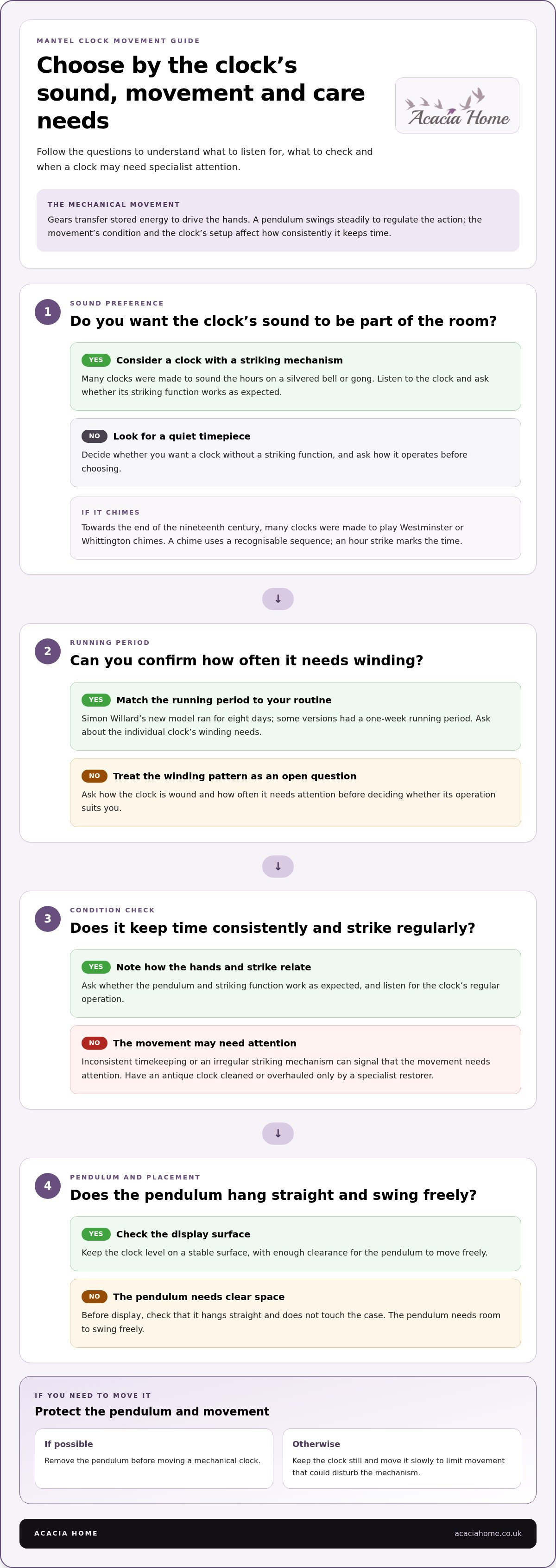
In a mechanical clock, the movement transfers stored energy through gears to drive the hands. A pendulum regulates the action by swinging steadily; the movement’s condition and the clock’s setup affect how consistently it keeps time.
Simon Willard’s Massachusetts shelf clocks show how designs varied. His new model ran for eight days, while some versions had a one-week running period and an extended base for the weight. Their pendulum length could be adjusted through a hole in the dial at 12 o’clock. These details help explain why similar-looking clocks may differ in operation.
There’s no universal service interval for every clock. Inconsistent timekeeping or an irregular striking mechanism can signal that the movement needs attention. Have antique clocks cleaned or overhauled only by a specialist restorer.
Pendulums and Chimes
A pendulum needs room to swing freely, so check that it hangs straight and doesn’t touch the case. When moving a mechanical clock, remove the pendulum if possible. Otherwise, keep the clock still and move it slowly to limit movement that could disturb the mechanism.
The striking mechanism adds sound as well as timekeeping. A large number of clocks were made to sound the hours on a silvered bell or gong. Towards the end of the nineteenth century, many were made to play Westminster or Whittington chimes. Listen for the difference: an hour strike marks the time, while a chime uses a recognisable sequence.
Before choosing a clock, consider whether you want a quiet timepiece or one whose sound becomes part of the room. Ask how it is wound and whether the pendulum and striking function work as expected. An eight-day clock needs winding on a different rhythm from one that requires attention more frequently, so its running period matters in everyday use.
Keep the clock level on a stable surface, with enough clearance for the pendulum to move freely. If it loses time, note whether the problem is steady or intermittent, and whether the strike still matches the hands. These observations can help distinguish a timekeeping issue from a striking problem without adjustments that might disturb the movement.
In a mechanical clock, the winding key, pendulum and chime are parts of one working arrangement. Handle the pendulum gently, avoid forcing the hands, and keep dust away from the case and dial. These simple habits support careful ownership, while an antique movement that needs cleaning or an overhaul requires specialist attention.
Buying considerations: condition, originality and authenticity
A careful inspection helps you judge a clock as both a working object and a piece of decorative craftsmanship. Start with the case, dial and movement, then compare their condition and style. For example, a polished case beside a heavily worn dial may show that the parts have experienced different histories.
Look closely at these areas before deciding:
Case: Check for cracks, chips, loose ornament and uneven finishes. Inspect corners and edges, where knocks can be easier to spot.
Dial and hands: Look for damage, discolouration and whether the hands sit neatly around the dial. Compare their style with the case rather than judging them alone.
Movement: Observe whether the clock runs and strikes consistently. Note any unusual noise, hesitation or visible damage without attempting to adjust internal parts.
Condition isn’t simply a matter of looking pristine. Age-related wear may be consistent with a timepiece’s history, while extensive damage can affect its function or appearance. Look for localised changes, such as a repaired corner or a patch of noticeably different finish. Record what you see rather than assuming every mark has the same significance.
Originality is about whether the visible components appear to belong together. Compare the dial, hands, case decoration and movement for a coherent design. A dial that looks strikingly different from the case, or ornament that appears newly fitted, deserves closer attention. These details don’t prove a clock has been altered, but they help frame questions about its history and condition.
Assess authenticity through evidence, not one feature alone. A maker’s name or signature can be useful, but it isn’t proof by itself. Consider the clock’s construction, materials, finish and design as a whole. For example, ask whether the case details and dial have a consistent style, and whether the movement’s layout appears compatible with the clock’s form.
Descriptions matter, too. Read them closely for clear statements about repairs, replacements, working condition and known alterations. A replacement dial, for example, is relevant to originality even if the case is well preserved. Note the stated features, then compare each claim with the clock itself.
Finally, weigh condition against your purpose. A collector may prioritise originality and documented history, while someone seeking a decorative working clock may focus on appearance and reliable operation. Use the same inspection steps for either choice, then decide which compromises matter most to you.
Traditional placement and design
A mantel clock can serve as a focal point or complete an existing arrangement. Placement affects how clearly the dial reads and how the case relates to nearby objects. Before choosing a spot, identify the main viewing position, such as a sofa facing the fireplace, then consider the clock’s height and visual weight from there.
On a fireplace mantel, treat the clock as the centre of a balanced composition. A broad, ornate case may hold its own, while a smaller design can sit alongside a framed photograph or candlesticks. Compare shapes and finishes rather than matching every object exactly. If the mantel already has a prominent mirror, avoid crowding the clock against it.
A shelf, sideboard or console table can also give a timepiece a considered place. A narrow shelf, for example, suits a compact case, while a wider sideboard gives a decorative design more room. Leave clear space around the clock so its outline remains visible. Check that the surface is steady and that you can read the hands from your usual seat.
Use these steps to judge a possible position:
Choose the viewpoint: Stand where you’ll most often see the clock, such as the living-room doorway, and check that the dial is easy to read.
Compare proportions: Set the clock against the mantel or furniture width. A broad case can dominate a slim console, while a small clock may disappear on a long sideboard.
Review nearby details: Place it beside objects with different heights, such as a low bowl or taller candlesticks, to create contrast without obscuring the dial.
Consider the room’s mood: A carved traditional case can complement classic furniture; a clean-lined design can feel at ease with contemporary pieces.
Colour and finish help connect the clock to the room without making it disappear into the setting. A dark case can stand out against a pale wall, while a lighter finish may soften a darker mantel. Consider nearby materials, such as timber, stone or painted surfaces, and decide whether you want harmony or contrast. Repeating a detail, such as a warm wood tone, can bring the arrangement together.
Consider sound and movement when deciding where to place the clock. A striking clock may suit a living room better than the space beside a quiet reading chair. For a pendulum model, allow room for movement and keep surrounding ornaments clear of its path. This simple check helps the clock function comfortably within the display.
Collectability and prices
Collectability can shape a clock’s appeal beyond its function and appearance. Price, in turn, reflects a combination of condition, originality, maker and demand.
Collectability Factors
Collectors often weigh a clock’s maker, age, design and surviving original parts together. A recognised name such as Simon Willard can attract interest, but a signature alone doesn’t establish authenticity or value. Look for a coherent relationship between the case, dial and movement, then consider whether the condition supports the clock’s history.
Rarity and craftsmanship may also influence desirability. An unusual case or carefully executed ornament can distinguish a clock from more familiar designs. Compare similar examples by their construction and preserved details rather than treating age as the only measure. A well-kept, original clock may appeal to a different collector than a heavily altered one.
Price Considerations
For UK buyers, market offers for mantel clocks typically range from £25 to £90, with a median of about £46. A market snapshot of 39 price samples from four sources was collected on 28 October 2026 and is valid until 27 November 2026. This range describes the wider market, not a price for every style or condition.
A clock’s case material, decoration, working state and originality all help explain its asking price. A simple decorative example and a scarce clock by a sought-after maker aren’t directly comparable. Condition matters, too: damage, missing components or visible repairs can affect how buyers assess an otherwise attractive piece.
Distinguish an asking price from evidence of collectability. A high price doesn’t prove rarity, authenticity or strong demand. Consider the clock’s overall condition, the consistency of its parts and the detail provided about its history. If it is described as original, look for supporting features rather than relying on the label alone.
Set your priorities before comparing clocks. If you want a decorative timepiece for everyday enjoyment, appearance and working condition may matter most. If collecting is your aim, originality, maker and documented history may carry more weight. In either case, compare like with like: clocks with similar case styles, materials and condition offer a more useful reference than those that share only a general type.
Keep a short comparison note for each clock: record its stated maker, materials, condition, originality and price. This makes differences easier to see and helps you judge whether a particular design suits your priorities. Explore mantel clock designs as you consider the style that belongs in your home.
Acacia Home: Occasional Chairs
Acacia Home offers occasional chairs to add a comfortable, considered accent to a living room where a mantel clock is a focal point. A chair beside a fireplace can create a welcoming reading corner, while a footstool adds a practical finishing touch. For a more generous place to pause, explore chaise longues and window seats. Dining chairs can bring the same thoughtful style to another part of your home.
Turn to Acacia Home when you’re furnishing a room around a treasured timepiece and want seating that complements its character. Browse the home furnishings and find pieces to suit your space and style.
Choose a detail that feels like yours
Choosing mantel clocks is also a chance to decide what atmosphere you want at home. You might prefer a subtle accent that settles naturally into the room, or a distinctive piece that creates a fresh focal point. Picture the setting around it: the furniture, finishes and everyday moments. Let those details guide your choice. A considered home gives each object a place while still reflecting the people who live there.
Acacia Home offers occasional chairs, dining chairs and footstools to help shape welcoming spaces around the pieces you treasure. Whether you’re exploring a new timepiece or considering how it will fit into your home, browse the collections on the Acacia Home website.
For a conversation about mantel clocks, contact Acacia Home. Your next thoughtful addition can make the room feel even more like yours.
Frequently Asked Questions
What are the main types of mantel clocks?
The main types include mechanical, battery-powered and design-led styles, and some clocks combine these categories. A mechanical example may use a pendulum and winding key, while a battery-powered clock uses an electronic movement. Clocks also vary by case style, such as classical, Art Deco or contemporary, and by sound: some strike or chime, while others keep time quietly. These differences shape both daily use and appearance.
How do antique and modern mantel clocks compare?
Antique examples often show period craftsmanship, aged materials and mechanical components, while modern clocks may favour cleaner cases and simpler operation. The distinction isn’t purely visual: older timepieces can have replaced parts or wear that affects function, while newer designs may prioritise ease of use over historical detail. Choose an antique for its individual character, or a modern clock for a fresh look and straightforward everyday timekeeping.
How do you set and wind a mechanical mantel clock?
Follow the clock’s instructions where available, as winding and setting arrangements vary by movement. Place it securely, identify the winding points and use the correct key, turning gently until you feel resistance. Don’t force the key or hands. Set the time according to the maker’s directions for that mechanism, then observe the clock’s running and striking during use. If it stops or behaves irregularly, don’t dismantle it.
How do you choose the right mantel clock size and style?
Measure the available surface and compare the clock’s height, width and depth with nearby furnishings. A broad case may suit a substantial fireplace, while a smaller design can sit comfortably on a narrow shelf. Consider the viewing distance, too: the dial should be legible from your usual seat. Decide whether the style should echo existing finishes or provide contrast, such as a sculptural case against a simple wall.
What should you check before buying an antique mantel clock?
Check the case, dial, hands and movement separately, then consider whether their styles appear consistent. Look for damage, repairs, replaced components and maker’s marks. Ask for a clear account of the clock’s history and condition, including whether it runs and strikes. Photographs of the dial, case details and movement can help you assess the piece, but compare what you see with the written description before deciding.