
Indoor lighting for your whole home, with prices and room advice
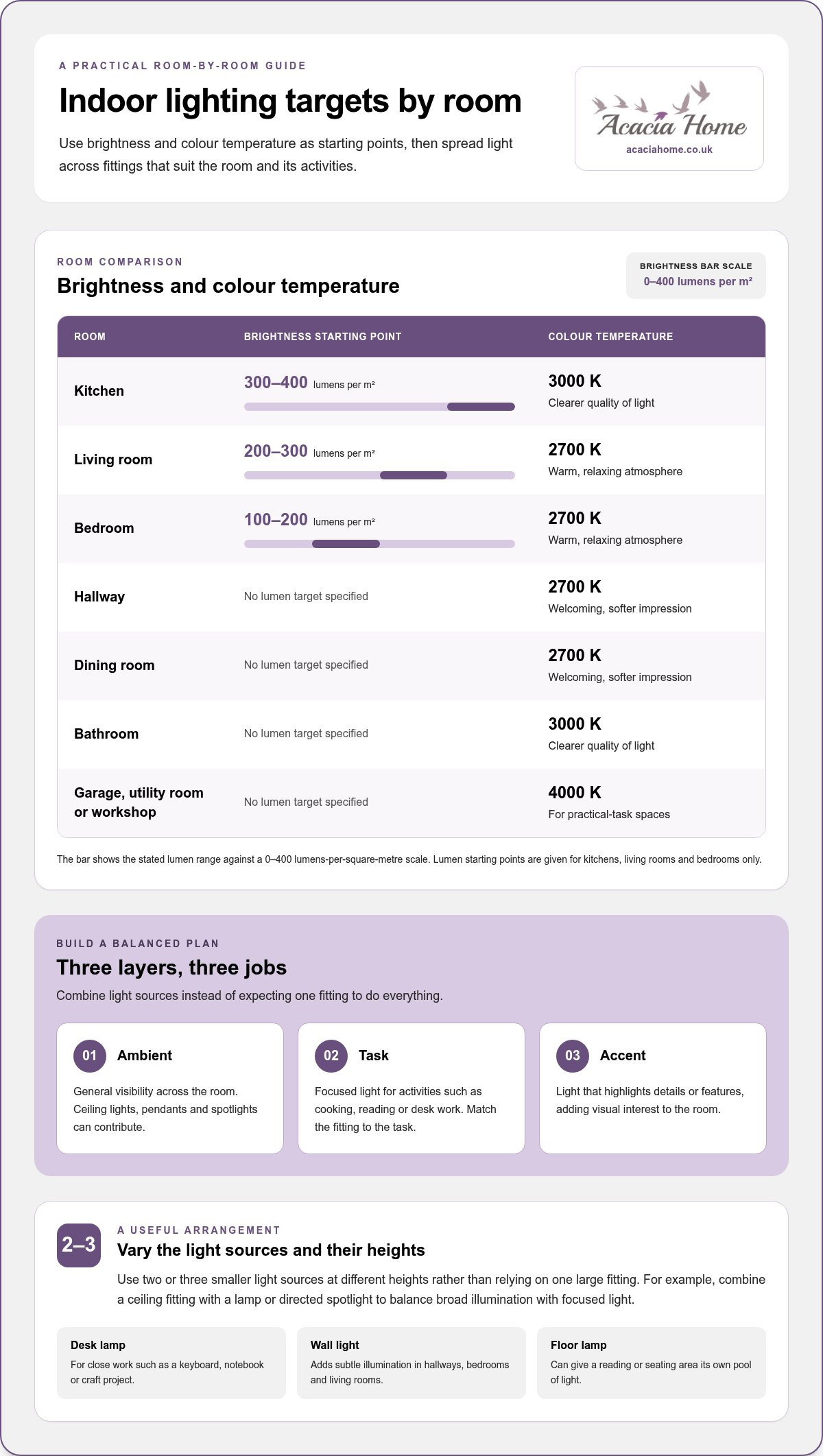
A whole-home indoor lighting plan works best when it layers ambient light for general brightness, task light for focused activities and accent light to highlight details. As a starting point, allow 300 to 400 lumens per square metre in kitchens, 200 to 300 in living rooms and 100 to 200 in bedrooms. Then spread the light across suitable ceiling, wall, table or floor fittings, rather than relying on one source alone.
A beautiful fitting can set the mood, but choosing indoor lighting also depends on the room’s size, ceiling height and how you use it throughout the day. This guide explains how to plan lighting room by room, choose fittings and colour temperatures, and compare options by the features and design that matter.
From a welcoming glow in the hallway to clearer light for cooking or reading, use these practical ideas to balance comfort, function and style throughout your home.
Table of Contents
What are the three main types of indoor lighting?
Plan a room around three layers: ambient light for general visibility, task light for activities and accent light to highlight features. Ceiling lights, pendants and spotlights can all contribute.
Ceiling lights and chandeliers
A ceiling light provides general illumination, while a chandelier can also become a striking feature. Choose a size and light spread to suit the room: ambient lighting is usually broader and more diffuse than focused task light. Consider the ceiling height too. Higher ceilings can accommodate larger fittings, while lower ceilings often suit a more compact profile.
Pendant lighting options
Pendant lights hang from the ceiling and can direct light over a dining table, kitchen island or entryway. Their suspended shape helps define an area, especially in an open-plan room. Consider the ceiling height, the space beneath the fitting and its purpose. A pendant above a table, for example, should light the surface without getting in the way of people seated around it.
Spotlights and recessed lighting
Spotlights direct light towards a chosen area, such as a kitchen worktop or a bookcase. Recessed lights sit within the ceiling, keeping the fitting visually discreet and useful where a pendant might feel intrusive. Think about beam direction and how the light will reach the room’s edges. A single 1,000-lumen pendant can leave edges dark, so several light sources may create more even coverage.
To choose between ceiling lights, pendants and recessed spotlights, start with the room’s purpose and ceiling height. Choose a broad ceiling fitting for general light, a pendant to define an area, or spotlights for directed illumination.
Replace a straightforward fitting yourself only if you understand the wiring and can work safely. For unfamiliar wiring or changes to fixed electrical circuits, use a qualified electrician.
UK electrical safety requirements vary depending on the work and where it takes place. Choose a fitting suitable for its position, and use a qualified electrician for fixed-wiring changes or bathroom lighting.
Recessed lights need suitable clearance around the fitting, and dimmers must be compatible with the bulbs they control. Mismatched components can affect dimming or performance, so check the lamp and control specifications before choosing them.
For layered lighting, combine a ceiling fitting with a lamp or directed spotlight. This balances broad illumination with focused light, rather than expecting one fitting to do everything.
Desk, wall and floor lights
Smaller fittings bring useful light closer to where you read, work or unwind. Combine a desk lamp, wall lights or a floor lamp with the main ceiling fitting to give each area a clear purpose.
Desk and wall lights
A desk lamp directs light onto a keyboard, notebook or craft project, helping distinguish a work area from the rest of the room. Wall lights attach directly to a wall and can add subtle illumination in hallways, bedrooms and living rooms. Position a reading light so it reaches your book without shining into your eyes. In a bathroom, choose a fitting suited to its intended position.
Floor lights
A floor lamp can brighten a reading corner without taking up space on a side table. Place it beside an armchair and angle the light towards your book or seat. Before choosing one, consider nearby furniture, available floor space and the route through the room. A lamp behind a chair, for example, can keep the reading area distinct from the main walkway.
Floor and table lamps
Table lamps work on side tables and desks, adding a pool of light at a lower level. Floor lamps can serve a similar purpose beside a sofa, with their own base and shade. Use both to create varied heights: a table lamp beside the bed can support evening reading, while a floor lamp near the living-room sofa brightens a separate seating area.
For a balanced arrangement, use 2 or 3 smaller light sources at different heights instead of relying on one large fitting. A desk lamp can handle close work, a wall light can soften a hallway, and a floor lamp can give a living-room corner its own glow. Task lighting should be smaller and more focused than ambient lighting, so match each fitting to the activity it serves.
At a desk: place the lamp where your hand won’t cast a shadow across your work.
Beside a bed: use a table or wall light that’s easy to reach from your usual reading position.
In a living room: pair a floor lamp with a table lamp to spread light across different seating areas.
Shape, shade and material also influence how a fitting sits within your home. If you’re considering a decorative focal point, explore ceramic, glass and concrete lighting alongside your plan for table, wall and floor lights.
What colour temperature should I use in each room?
Colour temperature affects a room’s atmosphere, from a restful glow to clearer light for concentration. Let the room’s purpose, décor and colour scheme guide your choice.
Colour temperature by room
For a straightforward starting point, use 2700K in living rooms, bedrooms, hallways and dining rooms. Choose 3000K for kitchens and bathrooms, then consider 4000K for garages, utility rooms and workshops. These recommendations help establish a consistent feel in rooms with similar uses, whilst giving practical spaces a brighter character.
Living room or bedroom: 2700K supports a warm, relaxing atmosphere.
Hallway or dining room: 2700K creates a welcoming, softer impression.
Kitchen or bathroom: 3000K offers a clearer quality of light.
Garage, utility room or workshop: 4000K suits spaces used for practical tasks.
Warm-white light at 2,700-3,300 K is described as relaxing and suitable for living and sleeping areas. Cool-white light at 3,300-5,300 K is associated with concentration, and suits kitchens, bathrooms, hallways and studies. The ranges meet at 3,300 K, so use the recommended room temperature as your practical starting point.
Lighting ambience and colour temperature
Kelvin, shown as K on a bulb or fitting, describes the colour appearance of its light. A lower value such as 2700K gives a warmer impression, whilst 4000K appears cooler. The effect is about the quality of the light, not how much light the fitting produces.
For a comfortable living room, begin with 2700K for general illumination, then choose lamps with the same colour temperature for reading or relaxing. A consistent tone helps the separate light sources feel connected. In a kitchen, 3000K provides a more practical look, while 4000K may suit a separate utility area used for focused tasks.
Existing colours and materials also affect how the light looks. Before choosing a bulb, consider whether the room has warm timber, pale walls, deep upholstery or reflective surfaces. These finishes can appear different under warm-white and cool-white light, so consider colour temperature alongside your décor rather than in isolation.
Step one: decide whether the room is mainly for relaxing, welcoming guests or completing tasks.
Step two: use the suggested temperature for that room as your baseline.
Step three: compare the bulb’s Kelvin marking with nearby finishes and fittings.
For open-plan spaces, use the room’s separate functions to guide choices. A dining area can use 2700K, whilst a neighbouring kitchen can use 3000K. Keeping each area’s fittings consistent helps the change in atmosphere feel deliberate rather than accidental.
Indoor lighting by room
Plan each room around its size, ceiling height, furniture and daily activities. As a starting point, estimate the total brightness needed in lumens per square metre, then distribute the light across suitable fittings. Separate switches let you adjust the atmosphere without turning on every fitting at once.
Use these room guides to estimate the total light output across all the fittings, rather than the output of a single bulb:
Kitchen: allow 300 to 400 lumens per square metre for preparation and everyday use.
Living room: allow 200 to 300 lumens per square metre for a comfortable, inviting balance.
Bedroom: allow 100 to 200 lumens per square metre for a softer, restful feel.
For example, a 4 m by 4 m living room is estimated to need around 4,000 lumens across its fittings. That’s a combined target, not a requirement for one bright ceiling light. Divide the output between a central fitting, a floor lamp and a table lamp to reduce gloomy corners and create a more flexible room.
Consider how each space is used before choosing fittings. In a kitchen, direct useful light onto work surfaces, then add broader illumination for the whole room. In a living room, combine general light with lamps near seating. A bedroom needs comfortable overall brightness and a separate reading light, so you can keep the atmosphere gentle.
Bathrooms often use flush ceiling lights and spotlights, which can suit compact ceiling layouts. In a dining room, a pendant can define the table, while wall or table lights add a softer glow. In hallways, spread light along the route instead of concentrating it in one spot.
Room shape matters as much as floor area. A long room may need fittings distributed along its length, while dark furnishings can make a space feel less bright than pale surfaces do. Measure the room, note the furniture and wall décor, then identify where light is most useful. A small fitting can look lost in a large room, while an oversized one can dominate a compact space.
For a main room, consider dividing the fittings into 3 or 4 separately switched groups. You could switch on the ceiling light for general use, then choose lamps for reading or a quieter evening. This also helps prevent a single 1,000-lumen pendant from leaving the room’s edges dark. Build a bright, welcoming scheme from several considered sources, each serving a clear purpose.
Indoor light prices and product features
Compare prices for fittings with similar functions, bulb requirements and finishes. A stylish pendant above a dining table, for example, serves a different purpose from a discreet ceiling fitting for general light.
Start with the fitting, then consider the bulb it uses and how you’ll control it. The purchase price is only one consideration: bulb compatibility, energy efficiency, dimming and design all affect practical value. Check the product details for the fitting type and whether a bulb is included.
A 7W LED bulb and a 60W incandescent bulb each provide roughly 800 lumens. That comparison shows why wattage alone isn’t a measure of brightness: lumens describe light output, while watts describe power use. For halogen and CFL options, compare bulbs with similar lumen output, then weigh wattage, purchase price and expected lifespan to assess running costs.
Light output: compare lumens when you need similar brightness.
Energy use: check the wattage for the bulb’s intended output.
Compatibility: match the bulb base and type to the fitting.
Controls: confirm dimming works with the bulb and switch combination.
Smart bulbs can be controlled from a mobile device and come in dimmable and multicoloured options. These features can change the feel of a room, but are most useful when you’ll use them. A dining area might benefit from dimming, for example, while a simple utility fitting may not need app control.
How much does it cost to install indoor lights in the UK? There is no single installation price. The work depends on whether an electrician is replacing an existing fitting or adding a new light point. Wiring changes, ceiling access and the number of fittings also affect the job, so compare quotes for the same work.
For a straightforward replacement, the existing wiring and mounting point shape the task. Adding a new pendant position may involve extra wiring and access work. Before requesting a quote, list each fitting, its location and whether it replaces an existing light. This makes it easier to compare like for like than asking for a general installation price.
When comparing decorative fittings, consider their material, shape and light distribution as well as their function. Glass can create a lighter visual presence, while ceramic or concrete can bring more pronounced material character to an interior. Think about how each finish relates to your dining furniture and surrounding décor.
Explore decorative lighting styles to compare materials and designs for your home.
Acacia Home: Occasional Chairs
Acacia Home offers occasional chairs to help complete a thoughtfully lit living space with considered seating. Once you’ve planned lighting for reading, conversation or dining, choose furniture that supports how you use each area. An occasional chair can create a comfortable spot beside a floor lamp, while a footstool makes a practical companion for relaxing.
For a dining area, explore dining chairs; for a quieter corner, consider chaise longues and window seats. These pieces help create distinct moments throughout the home, complementing the atmosphere set by your fittings.
Browse indoor furniture or visit Acacia Home online to explore the seating range.
Make your next lighting choice part of the bigger picture
A room’s atmosphere comes from more than its fittings. Consider how the light will work with your favourite places to read, dine and unwind, then choose pieces that make those moments feel considered. A well-planned indoor lighting scheme can help your home feel cohesive while giving each room its own character.
Acacia Home offers occasional chairs, dining chairs and footstools to help you shape comfortable spaces around the way you use your home. A chair beside a reading light or seating around a dining table can make a room’s purpose feel clear and welcoming.
As you refine your choices, explore lighting and furnishings that suit your home’s character. Explore Acacia Home’s lighting and home furnishings, and take the next step towards a home that feels warmly, distinctly yours.
Frequently Asked Questions
How do I plan lighting for a whole house?
Plan each room around its activities, then map the fittings and switches to suit. Mark where people read, cook, work, dine and move between rooms. In an open-plan space, treat the kitchen, dining area and lounge as separate zones, even if they share a ceiling. Make a simple room-by-room schedule of fitting types, bulb requirements and switches, then compare it with your furniture layout.
How many lumens does a room need?
Estimate total lumens by multiplying the room’s floor area in square metres by its recommended lumens per square metre. For example, a 3 m by 3 m kitchen has an area of 9 square metres, giving an estimated 2,700 to 3,600 lumens using the kitchen guide. Treat this as combined output from all fittings, then consider room shape, surface colours and where focused light is needed.
What is the 3 lighting rule?
The three-layer approach combines ambient, task and accent lighting. Ambient light provides general visibility; task light focuses on an activity, such as reading; accent light draws attention to a feature, such as artwork. In a living room, a ceiling fitting, reading lamp and picture light could serve these purposes. Switch the layers independently to suit different activities and moods.
What is the difference between lumens and watts?
Lumens measure the light a bulb produces, while watts measure its power use. To compare brightness, look at lumens first, not watts alone. For example, a 7W LED and a 60W incandescent bulb each provide roughly 800 lumens. If you’re choosing replacements, compare similar lumen output, then check wattage and fitting compatibility to understand energy use and whether the bulb will suit its intended socket.
What is the most common indoor lighting mistake?
Avoid relying on a single central fitting to light every part of a room. The area beneath it may be bright while the walls, furniture or reading spots remain dim. Consider where activities take place, then add separate sources where useful. For example, a table lamp beside a sofa can brighten a reading area without requiring the main ceiling fitting to illuminate the whole room at full brightness.
What are the main types of indoor lighting and where are they used?
The three main types are ambient, task and accent lighting. Ambient light, from sources such as ceiling fittings, provides overall illumination. Task lighting focuses on specific activities, such as writing at a desk. Accent lighting highlights a detail, such as a wall feature. A well-planned room can use all three, with each source serving a distinct purpose.
How many lumens do you need for each room in a UK home?
As a guide, allow 300 to 400 lumens per square metre in a kitchen, 200 to 300 in a living room, and 100 to 200 in a bedroom. These figures estimate the room’s total light across its fittings, not the output needed from each bulb. Calculate using floor area, then distribute the result among fittings according to the room’s layout and activities.
What colour temperature is best for different rooms?
Use 2700K as a starting point for living rooms, bedrooms, hallways and dining rooms; choose 3000K for kitchens and bathrooms. Garages, utility rooms and workshops can suit 4000K. Kelvin indicates whether light appears warmer or cooler, rather than its brightness. For an open-plan home, choosing a consistent temperature within each functional area helps make the change between dining, cooking and relaxing zones feel intentional.
Comments