
How to Arrange Furniture with a Chaise Longue: A Room-by-Room Guide
What if the best place for your chaise longue isn’t against a wall? Giving it some breathing room can help define a reading nook or make an open-plan space feel more considered. But arranging furniture with a chaise longue can be tricky when you’re balancing the room’s focal point, clear walkways and space for everyday seating.
If you’re deciding whether to let the chaise float or tuck it into a corner, start by considering which way its lounging section will face. A thoughtful position can help the rest of the room fall into place, rather than compete for space.
This guide covers how to choose a position, keep routes through the room clear and balance the chaise with useful companion furniture. Explore ideas for living rooms, bedrooms and open-plan areas, with practical checks to help you create a layout that feels welcoming and works for everyday use.
Table of Contents
Start arranging furniture with a chaise longue by reading the room
Choose the chaise longue's position, orientation and relationship to seating
Balance a chaise longue with rugs, tables and other furniture
Arrange furniture with a chaise longue in small and open-plan rooms
Refine your chaise longue arrangement for everyday comfort and style
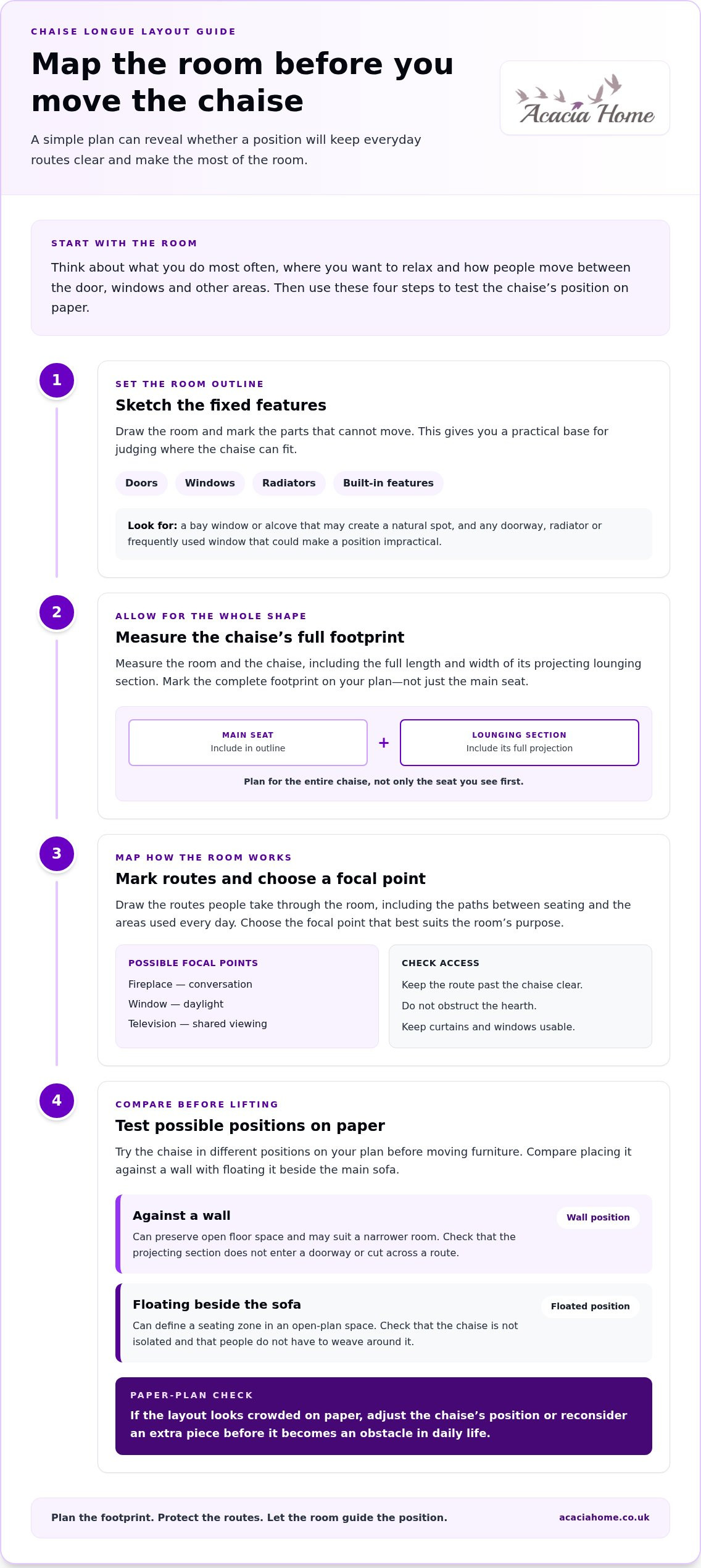
Start arranging furniture with a chaise longue by reading the room
A chaise longue feels like part of the room, rather than an oversized extra, when its position works with the space around it. Before moving furniture, consider what you do in the room most often, where you want to relax and how people move between the door, windows and other areas. These observations give arranging furniture with a chaise longue a practical starting point.
Room shape matters as much as floor area. In a long, narrow room, placing the chaise along a wall may preserve a clear route. In a more open room, floating it can help define a separate lounging zone. Look at openings and fixed features, too. A bay window or alcove may create a natural spot, whilst a doorway, radiator or frequently used window may make that position impractical. Natural light can guide a reading nook, as long as the chaise remains easy to reach and use.
Sketch the room before testing positions. Mark doors, windows, radiators and other fixed features, then add the main furniture and the routes you use every day. This simple plan can show whether the chaise’s projecting section will interrupt the flow before you start shifting heavier pieces.
Which focal point should guide your chaise longue layout?
Choose the feature that best suits the room’s purpose: perhaps a fireplace for conversation, a window for daylight or a television for shared viewing. Angle the chaise’s lounging section towards that feature so the seat feels inviting and useful, rather than pointing into an awkward corner. A chaise longue has evolved through different forms and styles; Chaise longue offers a concise historical overview that may help you recognise the character of the piece you’re arranging.
Keep access in mind as you set the angle. A chaise facing a fireplace shouldn’t obstruct the hearth, and one beside a window shouldn’t prevent you from opening curtains or reaching the window. The focal point should support the room’s everyday activities, not take priority over them.
How can you assess the room before moving furniture?
Measure the room and the chaise, including the full length and width of its projecting lounging section. Note door swings, routes between seating and any fixed architectural features. A simple plan, drawn roughly to scale, makes it easier to compare a position against a wall with a floated one and see how each affects the space around it.
Sketch the room, including doors, windows, radiators and built-in features.
Mark the chaise’s complete footprint, not just the main seat.
Draw the routes people take through the room and identify your focal point.
Try possible positions on paper before moving furniture into place.
Think about the room as a whole, not just the chaise’s spot. Compare your plan with the range of indoor furniture options as you decide what else the arrangement needs. If a layout looks crowded on paper, adjust the position or reconsider an extra piece before it becomes an obstacle in daily life.
Choose the chaise longue's position, orientation and relationship to seating
Once you understand how the room works, compare possible positions by considering what the extended seat will do to the layout. A chaise isn’t simply another chair: its lounging section needs room, and its direction can either draw the eye towards the rest of the seating or make the piece feel separate. The best arrangement depends on the floor plan, the focal point and how you want to use the space.
Should a chaise longue sit against a wall or float?
A position against a wall can work when it keeps the centre of the room open and leaves a comfortable route past the chaise. It may suit a narrower room, or a layout where the sofa and other seating already occupy the central area. Check that the projecting section doesn’t jut into a doorway or cut across the route between frequently used parts of the room.
Floating a chaise can help define a seating zone in an open-plan space, particularly when there isn’t a natural wall to anchor the arrangement. Place it beside the main sofa rather than leaving it isolated in the middle of the room, and use the lounging section to suggest where the seating area begins. If people have to weave around it to cross the room, try another position.
How should the chaise face the sofa or focal point?
Consider where you’ll look whilst relaxing. The extended section might face a window, fireplace or television, or angle towards the sofa to make conversation easier. An L-shaped arrangement can work well when the chaise’s shorter end meets the sofa, creating a connected seating group without lining every piece up against the walls. Leave room for people to sit down and get up without squeezing past the projecting seat.
Left- and right-facing configurations change which side the lounging section extends towards, so the same arrangement won’t suit every model or room. Check the orientation shown for the chaise you’re considering, then compare it with the space beside the sofa. There’s no universally correct side: choose the one that faces the focal point naturally and avoids cutting across your usual route.
For a useful sense of how proportion and balance affect furniture placement, see the Key Principles of Furniture Arrangement. Apply those ideas to the chaise’s full shape, not just its main seat.
Use this quick comparison to shortlist a position before moving furniture:
Against a wall: Suits rooms where preserving open floor space matters. Check whether the lounging section projects into a route.
Floating beside the sofa: Suits open-plan layouts or a central seating group. Check whether the chaise defines the area without interrupting movement.
Left- or right-facing: Choose the side with room for the extended seat. Consider the focal point, sofa position and everyday access.
As you compare layouts, browse chaise longues and window seats to picture how different pieces might sit within your arrangement.
Balance a chaise longue with rugs, tables and other furniture
Once the chaise is in position, use nearby pieces to make the arrangement feel purposeful and comfortable. The aim isn’t to fill every gap. A rug can bring the seating together, whilst a well-placed table makes lounging more convenient. Extra chairs should support conversation without crowding the room. When arranging furniture with a chaise longue, consider its extended shape before adding anything else.
How can a rug make the chaise arrangement feel cohesive?
Think of a rug as a visual anchor, not a boundary that every furniture leg must follow. It can link the chaise to a sofa or occasional chair, helping the group read as one considered area. Choose a size that relates to the whole arrangement, including the chaise’s projecting section. If the rug sits only beneath the main seat, the extended end may look disconnected.
Before settling on a rug, check its edges against the room’s routes. You should be able to walk around the seating without repeatedly stepping over a corner or squeezing between the rug and furniture. In a smaller room, a rug that defines the group without covering most of the visible floor can help the arrangement feel balanced.
Where should tables and extra seating go?
Place a side table beside the part of the chaise where you naturally rest, so a book or drink is easy to reach without leaning across the lounging area. A coffee table can serve the wider seating group, but leave enough room to move between it, the chaise and other seats. Its shape and scale should complement the space without making the extended section awkward to enter or leave.
An occasional chair can complete the conversation area if it faces the chaise or sofa comfortably. Angle it towards the group instead of placing it in the route through the room. If the space feels tight, try the arrangement without the extra chair first.
Use this quick pros-and-cons check before adding or repositioning a table:
Add a side table: It keeps everyday items close to hand. It also takes up floor space beside the chaise, so avoid narrowing a walkway.
Add a coffee table: It gives the seating group a shared surface. It may crowd the centre if the chaise’s extended end already projects into that space.
Reposition or omit a table: Moving it to the end of the chaise, or leaving it out, can open up circulation. You’ll have less surface space, so keep only what supports how you use the room.
For a final check, sit on the chaise and stretch out as you normally would. Can you reach what you need, and can someone else pass without disturbing you? If not, adjust the table or chair before adding decorative pieces. Open floor can be just as valuable as another furnishing.
Arrange furniture with a chaise longue in small and open-plan rooms
A compact room asks every piece to justify its footprint, whilst an open-plan space needs definition without losing its sense of flow. In either setting, arranging furniture with a chaise longue is easier when you test its full shape before shifting the room around it. A paper plan or temporary outline on the floor can show whether the chaise fits in real life, not just in your imagination.
Use this sequence to try a layout before committing to the move:
Measure the space. Record the room’s dimensions and note door swings, windows, radiators and the route you use most often.
Mark the chaise footprint. Use its actual length and width, including the extended lounging section, rather than estimating from the main seat.
Test a position. Draw the chaise on a simple floor plan, or mark its outline on the floor with masking tape or sheets of paper. Try more than one orientation.
Check movement. Walk the usual routes, open doors and reach the areas you use. Adjust the outline if the chaise makes an everyday task awkward.
What layout choices help a chaise longue work in a small room?
In a compact room, start with the chaise’s actual footprint and protect the route between the entrance and the places you use daily. A position against a wall may preserve more open floor, but check that the lounging end doesn’t obstruct a door or access to a window. Choose companion pieces with a clear purpose, such as a nearby table, rather than filling every spare corner.
Try the taped outline for a day and notice whether you naturally walk around it or keep moving it out of your way. That practical test can reveal more than a plan alone.
How can a chaise longue define an open-plan seating area?
In an open-plan room, position the chaise to suggest the edge of the seating zone, perhaps with its back towards a dining area and its lounging end facing the sofa or focal point. Keep routes between connected areas open and easy to follow. The chaise should guide movement, not form a barrier. Check the arrangement from the entrance and adjoining spaces so it feels integrated from each approach.
A rug or sofa can help reinforce the seating zone, but leave enough visual and physical space around the chaise for the wider room to feel connected. If the taped outline closes off a route, rotate or shift it and test again.
Once the layout works on the floor, move the chaise into place and reassess it from the same viewpoints. For a compact room, explore chaise longues and window seats as you consider which seating option could suit your space.
Refine your chaise longue arrangement for everyday comfort and style
A layout can look balanced on paper yet feel different once you begin using it. Before calling the arrangement finished, give it a practical trial: settle into the chaise, stretch out fully, reach for a nearby surface and walk through the room as you normally would. These checks help show whether the placement supports your routines as well as the look you want.
What should you check before settling on the final layout?
Test the arrangement in the ways you use the room. Check that doors open freely, windows remain accessible and the chaise doesn’t interrupt the room’s main activity, whether that’s conversation, watching television or reading. Make sure other seats are easy to reach, too, and that using a table doesn’t require an awkward lean or detour around the extended end.
Then look at the room from more than one position. From the doorway, does the chaise welcome you in or make the entrance feel tight? From the main sofa or favourite chair, does it feel connected to the seating group? If its outline seems too dominant from one angle, shift it slightly or turn it to open up the view. A small adjustment may be enough; there’s no single formula that suits every room.
Sit and stretch: Check that the lounging section feels usable without forcing you into an awkward position.
Move around: Follow your usual route through the room and make sure it remains natural.
Look again: Assess the balance from the doorway and from the seats you use most.
How can the chaise feel like a considered part of the room?
Once the position feels right, use a subtle detail to connect the chaise with the rest of the scheme. Echo a colour in a cushion, pick up a similar texture in a throw or repeat a curved shape in a nearby accessory. A small, thoughtful link can help the chaise belong without making every furnishing match. Keep the surrounding area edited so the shape of the piece remains part of the room’s character.
Let the intended use guide the finishing touches. A reading spot may benefit from a light positioned to illuminate the page without shining directly into your eyes; a place for conversation might feel more inviting with softer ambient lighting. Keep accessories within reach, but leave the lounging area clear enough to relax in. Reassess the effect in daylight and after dark, since the mood and balance can change as the light shifts.
Good arranging furniture with a chaise longue comes down to balancing comfort, access and cohesion. If you’re considering which piece might suit your room, explore chaise longues and window seats for inspiration across different interior layouts.
Make your room’s next chapter your own
A comfortable layout doesn’t need to be perfected in a single afternoon. Live with your arrangement, notice how the room feels at different times of day and let your habits guide any final touches. A small shift in position or a carefully chosen accent can help the chaise feel at home, whilst keeping the space personal and easy to enjoy.
If you’re ready to find a piece that suits your room and the way you like to unwind, Acacia Home offers chaise longues and window seats. Explore the selection for inspiration as you continue arranging furniture with a chaise longue, and picture how a considered new seat might settle into your home.
Explore chaise longues and window seats to find a piece for a room that feels welcoming, restful and distinctly yours.
Frequently Asked Questions
Can a chaise longue go in front of a window?
Yes, provided it doesn’t prevent you from opening the window, operating blinds or reaching the sill. Before placing it there, consider how the curtains fall and whether the chaise will sit comfortably without pressing against a radiator. A window spot can make a pleasant place to read, but check it at different times of day too: bright daylight or reflections may affect how comfortable it feels for resting.
Should a chaise longue face left or right?
Choose the orientation that lets the extended section face the view or activity you enjoy, whilst fitting the room’s available space. Left and right can be described from different viewpoints, so use the specific chaise’s product image or layout diagram to understand which side projects. Then mark that shape on the floor. This makes it easier to see whether it suits the room before you decide where it belongs.
Can you put a chaise longue in a bedroom?
Yes, a chaise longue can create a separate spot for reading, dressing or taking a quiet pause in a bedroom. A corner near a window may work if it doesn’t block wardrobe doors, drawers or the route between the bed and the entrance. In a shared bedroom, consider whether someone can pass while another person is using the chaise. Keep the area calm and avoid letting it become a place for accumulating laundry.
How much space should you leave around a chaise longue?
A practical guideline is to preserve 24 to 30 inches of clear walkway around the chaise where people need to pass. Measure from its widest projecting point, not only the main seat, and allow extra room where a door swings or drawers open. For a side table, aim to keep it within 12 to 18 inches of the seat for an easy reach. Adjust these guides to suit your furniture and household.
Can a chaise longue be placed in the middle of a room?
Yes, if the room has enough space for people to move around it comfortably. A chaise in the centre can act as a feature, particularly in a larger living room, but consider what its back looks like from the entrance and nearby seating. A rug or console behind it may help the grouping feel intentional. If it divides the room awkwardly or interrupts a regular route, try shifting it off-centre.
Can you place a coffee table beside a chaise longue?
Yes, but a coffee table usually works best in front of the seating group, whilst a smaller side table may be more practical beside the chaise. If you place a coffee table next to the extended seat, check that its corners won’t catch people walking past and that it doesn’t limit space to stretch out. Try the position with a book or cup in hand to see whether the surface is genuinely convenient.
Is a chaise longue suitable for an open-plan living room?
Yes, a chaise longue can help an open-plan living room feel more clearly arranged without adding a screen or divider. For example, place it beside a sofa to suggest the edge of the lounge area, keeping the route to the dining space unobstructed. Check the view from the kitchen and entrance as well as from the sofa. The layout should feel connected from each approach, not as though the chaise has been left in the way.
Comments