
Are tub chairs comfortable for the elderly? A guide
Updated: 4 days ago
A tub chair’s welcoming curves can look supportive, yet the same shape may make it harder for someone to sit down or stand up. So, are tub chairs comfortable for elderly people? They can be, but comfort depends less on the silhouette alone than on how the chair fits the person who’ll use it.
If you’re weighing a cosy seat against concerns about movement, look beyond appearance. Seat height and depth, cushion firmness, arm position and the space around the chair can all affect how easy it feels to use. This guide explains what to assess, when a tub chair may be less suitable, and when another style or specialist advice could be a better fit. It also covers how to balance everyday comfort with the character of your room. Acacia Home’s indoor furniture range includes tub and occasional chairs, giving you styles to consider once you know what the intended user needs from a seat.
Table of Contents
Are tub chairs comfortable for elderly people? Start with the shape
A tub chair can feel comfortable for an older person, but its suitability depends on the individual, the chair’s proportions and how easily they can use it. The familiar shape has a rounded back and sides that curve forwards to form the arms. This creates a distinctive, gently enclosed seat, but it won’t feel right for everyone.
It helps to distinguish an everyday tub chair from seating selected around assessed care or mobility needs. An occasional chair is home furniture; its shape or cushioning shouldn’t be taken as evidence of clinical or therapeutic support. A specialist seating assessment, by contrast, considers the person’s particular posture, movement and health requirements.
Comfort comes from how the seat, back and arms fit the person using the chair, not from a feature guaranteed by its shape. That’s why two people can sit in the same tub chair and come away with very different impressions.
What does a tub chair feel like to sit in?
The curved back and arms can create a snug place to settle, which some people may find cosy for reading or conversation. The sides give the chair a softer outline than an open-arm design, helping it feel like a welcoming part of a living room.
That enclosed feel is a matter of preference, not proof of therapeutic support. Someone who likes room to move their elbows, turn their body or approach from the side may find the curved arms restrictive. If possible, let the intended user sit in the chair and notice how the shape feels in practice.
When might a tub chair not be the right fit?
Proportions can change the experience considerably. A seat that is too low may make standing feel more effortful; one that is too deep can make it difficult to sit back comfortably. Arm position matters too: if the arms don’t meet the user naturally, they may not provide a convenient place to rest their hands or push against when rising.
Pay particular attention if the person has difficulty sitting down or standing up. Don’t rely on the curved sides to solve that challenge, and don’t assume a chair is suitable just because it looks supportive. The useful question is whether the individual can use it comfortably and confidently.
Where posture, mobility or health needs are complex, seek an assessment from an appropriate health or mobility professional before choosing everyday furniture. Acacia Home’s indoor furniture range includes tub and occasional chairs. Start with the person’s needs, then bring the room’s style into the decision.
Which tub-chair details affect comfort, posture, and ease of movement?
The question “are tub chairs comfortable for elderly people?” is best answered by looking closely at how the chair fits its intended user. A graceful curved outline tells you little about the seat’s height or depth, and those proportions can affect how easy it is to settle, sit upright and rise again.
Think of comfort as a practical combination: check seat height, seat depth, back support, arm position and freedom of movement together. A chair may feel pleasant at first, yet become tiring if the sitter can’t rest their feet comfortably or find a natural position for their back.
How should seat height and depth feel?
With the person sitting as they normally would, notice whether their feet rest comfortably on the floor and whether their knees feel at ease. If the seat is too high, their feet may dangle; if it’s low, getting up may take more effort. A deep seat can leave a shorter-legged person unable to sit back against the backrest while keeping their feet comfortably supported.
Where possible, assess the intended user in a similar seated position before deciding. Measurements can help compare chairs, but the person’s experience matters too. Check the stated seat height and depth, then compare them with a chair they already find comfortable.
Do curved arms make a tub chair easier to use?
Arms give the sitter somewhere to rest their hands, but their height, width and curve vary between chairs. Notice whether the person can place their hands naturally, without reaching awkwardly or feeling squeezed. The enclosed sides may also make it harder for some people to enter or leave from the side, particularly if they’re used to approaching a more open chair.
Arms shouldn’t be treated as a guarantee of safer movement or as a way to manage a health condition. Consider how the person actually uses them.
For a helpful comparison, observe what happens during an ordinary sit and stand, rather than judging the chair from a brief glance. Does the sitter lower themselves in a controlled way? Can they sit back without sliding forwards? Do they have room to move their legs and turn comfortably? If pushing up from the arms is part of their usual movement, check whether they can reach and use them without twisting or leaning uncomfortably.
It can help to note the answers to these questions:
Can the person sit with their feet comfortably supported?
Can they rest against the back without being pushed forwards by the seat depth?
Do the arms meet their hands at a natural height?
Can they sit down, adjust their position and stand up without struggling?
These observations are useful for comparing occasional chairs, including those in the indoor furniture range, but they aren’t a clinical assessment. If mobility, posture or health needs make seating choices complex, seek advice from an appropriate health or mobility professional.
Tub chairs compared with other seating for older adults
Different chair shapes offer different experiences, but no category is automatically right for every older person. A tub chair’s curved, enclosing outline may feel cosy, while an open-arm occasional chair can offer more room at the sides. A riser-recliner is a different type of seating, with features that may suit particular movement needs. Compare the general shape and purpose, then consider how the individual sits, moves and uses the chair.
This is a broad comparison, not a fit test. Two chairs in the same category can feel quite different, and the person’s dimensions, posture, preferred way of sitting and ability to move all matter. An everyday occasional chair may suit one person comfortably, whilst another may need seating selected around assessed requirements. If standard home furniture doesn’t meet those needs, consider specialist seating and appropriate professional advice.
Tub chair or open-arm occasional chair?
A tub chair’s continuous curve can feel snug, but it may limit space for turning or approaching from the side. An open-arm occasional chair has a less enclosed outline, which some people may find easier to move around. Neither shape is best for everyone: compare how the intended user sits, shifts position and gets up. For broader style and selection pointers, explore our indoor furniture range.
When is a riser-recliner a different kind of solution?
Some riser-recliner designs include a lift function to help the seated person move towards standing. That feature isn’t part of a standard tub chair, so the two types shouldn’t be treated as interchangeable. If rising, transfers or comfortable positioning raise significant concerns, seek advice from an appropriate health or mobility professional about seating suited to assessed needs. For families exploring dedicated mobility support and daily living aids, online resources such as usamedicalsurgical.com provide a helpful reference for available home healthcare equipment.
When comparing options, focus on what happens during ordinary use, not just how each chair looks in the room. Can the person get into the seat in their usual way? Do they have enough room to move their legs and arms? Can they change position and rise without marked difficulty? These observations can help clarify whether the choice is between two everyday chair shapes or whether more specialised support should be considered.
So, are tub chairs comfortable for elderly people? They may be a pleasing and comfortable choice when their shape and fit work for the individual. An open-arm chair may feel freer to someone who dislikes enclosed sides, while a riser-recliner may be relevant where its specific features meet an assessed need. The person’s experience should guide the decision, rather than an assumption that one design is universally more comfortable.
How to assess a tub chair for comfort before choosing one
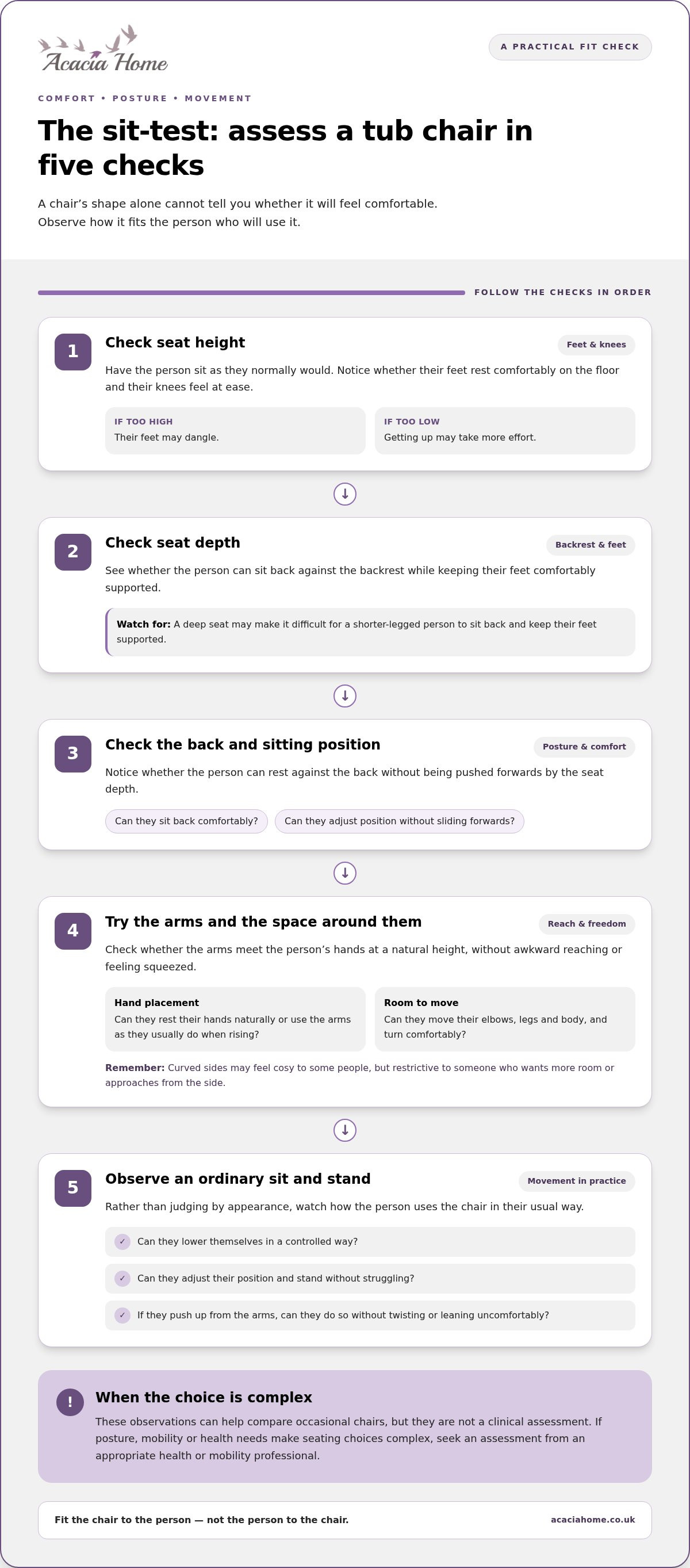
Start with the person’s everyday needs, not the chair’s colour or how neatly it fills a corner. If you’re asking “are tub chairs comfortable for elderly people?”, an orderly sit-test can reveal more than appearance alone. Try a comparable chair in person where practical, and observe how the user gets in, settles, changes position and gets out. No single measurement guarantees a good fit.
Begin with their routine. Consider how they’ll use the chair, for example for a short rest, reading or longer periods of sitting. Ask what feels comfortable and which movements tend to be difficult.
Watch how they settle. Notice whether they can sit without feeling squeezed by the curved sides, and whether they can adjust their position without repeated effort.
Check feet and back contact. See whether their feet rest comfortably and their back meets the chair in a relaxed position, rather than leaving them perched forwards or slumped.
Observe how they use the arms. Do their hands find a natural resting place? If they usually press on the arms when standing, notice whether they can do so without awkward reaching or twisting.
Look at the whole movement. Pay attention to sitting down and getting up, as well as any discomfort, repeated repositioning or hesitation. Don’t dismiss difficulty simply because the chair looks inviting.
What should you check when sitting in the chair?
Give the person time to settle in their usual way, then ask how the seat, back and sides feel. Notice whether they seem comfortably supported for the planned sitting period or keep shifting to find a better position. One quick sit may not show how the chair feels over time, so consider their usual routine and any discomfort they report.
How should the chair work in the room?
Once the chair feels suitable to the user, consider its place in the home. Leave clear space for their usual approach and for moving their legs or turning, rather than pushing the chair into a tight corner to make the layout look tidy. Check its proportions against nearby furniture while keeping practical access in mind.
Appearance still matters. Fabric and colour help a chair sit comfortably within the room’s character, but consider them after assessing everyday fit and movement. A beautiful choice should feel welcoming without making the route to or from the seat awkward.
With those priorities in mind, browse Acacia Home’s indoor furniture selection to explore tub and occasional chairs for the home.
Choosing a tub chair that feels right at home
The right chair should work for the person who’ll use it and feel at ease in the room. Begin with comfort and movement: a beautiful tub chair isn’t automatically suitable for every older person, and no decorative detail can make up for a shape that feels awkward to sit in or leave. Once the chair has passed those practical checks, you can choose a style that belongs in the home.
How can a tub chair complement a home interior?
A rounded tub chair can bring a soft, welcoming accent to a sitting room or bedroom, adding a curved outline amongst straighter furniture. Consider how its colour relates to the walls, curtains and nearby pieces, and whether the upholstery’s appearance suits the room’s mood. These styling decisions are separate from judging how comfortably the intended user can sit and move.
Think about the chair as part of a considered arrangement, rather than a standalone feature. A tub chair beside a reading lamp may create a cosy corner; one placed near a window can soften a room with angular lines. Compare its overall proportions with the surrounding furniture, too. A chair that looks balanced in a spacious room may feel imposing in a smaller one, so consider the space it occupies and how it sits alongside existing pieces.
Colour and upholstery appearance can connect the chair to a favourite scheme or introduce a gentle contrast. For instance, seating specialists like Woonloods illustrate how leather tub chairs and armchairs can pair durable, easy-to-clean materials with inviting interior style. You might echo a tone already present in cushions or curtains, or let the chair add a fresh note to a more neutral setting. There’s no need to rush this part: choose a chair that complements the room without taking attention away from the person’s everyday comfort.
Where can readers explore suitable indoor seating?
Acacia Home’s range includes occasional and tub chairs, giving you different silhouettes to consider for the home. If you’re weighing a tub chair against other styles, a guide to choosing occasional chairs can offer broader ideas for thinking about shape and the room. Keep the intended user at the centre of the decision, then explore colours and forms that feel harmonious with your interior.
As a final sense-check, picture the chair in the user’s usual routine as well as in the room. Does it suit the way they’ll approach and use it? Does its presence feel inviting rather than in the way? A successful choice brings practical comfort and personal style together, without assuming that a particular design suits everyone.
Ready to explore seating for your home? Browse indoor furniture and look for a chair that feels right for both the person and the space.
Make your next chair choice with confidence
A chair can shape the feel of a favourite corner, but the most rewarding choice is one the person can use comfortably as part of everyday life. If you’re still asking, “are tub chairs comfortable for elderly people?”, let the intended user’s own experience guide you. Their comfort, confidence and preferences matter more than choosing a particular style simply because it looks right.
Consider how the chair will fit into the person’s routine and home. Acacia Home offers indoor seating, including occasional and tub chairs, for customers across the United Kingdom. Explore the range with the intended user’s needs in mind, and let practicality guide you towards a style that feels at home.
Explore Acacia Home’s indoor furniture and find a seat that brings personal comfort and room character together.
Frequently Asked Questions
Are tub chairs a good choice for older people with back pain?
There’s no universal answer: the question “are tub chairs comfortable for elderly people with back pain?” depends on the person and the particular chair. Back pain can make some positions uncomfortable, so notice whether the sitter can settle without needing to brace or keep shifting. If pain is ongoing, worsens when sitting, or makes choosing a seat difficult, seek guidance from a GP or an appropriate health professional rather than relying on chair style alone.
Can an older person use a tub chair with a walking frame?
Possibly, if there’s enough clear space to approach, turn and sit without the chair or its curved sides obstructing the frame. Think through the usual route from the doorway and where the frame will be placed once the person is seated, keeping it accessible without blocking their way out. Don’t assume the chair’s arms are a substitute for the frame. If managing both feels uncertain, ask a mobility professional to assess the set-up.
Are tub chairs easy to get out of for someone with limited mobility?
Not necessarily. The ease of standing depends on the person’s movement and how the chair works for them; some may find an enclosed shape awkward to approach or leave. If getting up is difficult, don’t encourage repeated attempts just to test a chair. Consider whether another style or specialist seating may be more suitable, and seek professional advice if transfers or standing raise safety concerns.
Can a tub chair be used for sleeping overnight?
A tub chair is intended as a seat, not a bed, so it shouldn’t be assumed to provide suitable overnight sleeping. Its shape may restrict the space available to change position, and a person could find it uncomfortable over a long period. If someone regularly needs to sleep sitting upright or cannot use a bed, discuss the reason and appropriate arrangements with a health professional or care team.
Do tub chairs come in different seat heights and depths?
Yes, dimensions can differ between chairs, so don’t assume every tub chair has the same seat height or depth. Look for the stated measurements in the product information and compare them with a chair the intended user already finds comfortable. Measurements are a useful guide, but they can’t account for every person’s posture or proportions. If possible, arrange a practical sit-test before making a decision.
Should I ask an occupational therapist about a chair for an elderly relative?
Yes, an occupational therapist may be able to help if your relative has complex mobility, posture or daily-living needs, or if ordinary seating makes sitting and standing difficult. They can consider how the person uses a chair at home and whether specialist seating should be explored. For less complex choices, the person’s own experience can help guide selection, but seek professional advice whenever health or safe movement is a concern.
Comments