
The Large Ottoman: A Comparison Guide to Scale, Style, and Function
- info642352
- Jul 30
- 12 min read
Could your traditional coffee table actually be the one thing holding your living room back from feeling like a true sanctuary? Many of us long for the tactile warmth of a large ottoman to anchor our seating area, yet we often hesitate because we're worried about overwhelming the floor plan or dealing with the inevitable spills of family life. It's a common dilemma to crave that soft, curated look whilst fearing that a fabric surface won't provide the stability needed for your evening tea or a stack of favourite magazines.
We understand that your home is an extension of your identity, and choosing the right centrepiece is about more than just measurements; it's about creating a space where guests feel welcome and you feel completely at ease. In this guide, you'll discover how to transform your living space by choosing the perfect large ottoman that balances grand scale with everyday practicality. We'll walk you through the nuances of scale, fabric durability, and the clever styling tricks that turn a soft footrest into a functional, stylish focal point for your home.
Table of Contents
The Grandeur of Scale: Defining the Large Ottoman’s Role
A large ottoman is often the unsung hero of a well-curated living space. While its origins trace back to the rich history of the ottoman in the 18th century, today's versions serve a much more complex role in the modern British home. It's no longer just a place to rest tired feet after a long day. Instead, it has evolved into a multi-functional anchor that defines the very boundaries of your relaxation zone, acting as a sophisticated bridge between your seating and the rest of the room.
In many spacious or open-plan living rooms, furniture can often feel like it's "floating" without a clear sense of purpose. A standard coffee table might be too slight to bridge the gap between a sprawling corner sofa and the rest of the room, leaving the middle of the floor feeling empty and disconnected. This is where the large ottoman proves its worth. By occupying a more significant footprint, it creates a visual weight that pulls the seating arrangement together. This transforms a collection of separate pieces into a cohesive sanctuary that feels grounded and intentional. Psychologically, the presence of such a substantial, soft item signals to the brain that this is a zone for rest, lowering the energy of the room and making it feel more like a private retreat than a thoroughfare.
Beyond the Footstool: A Multi-Functional Marvel
The true beauty of these pieces lies in their incredible versatility. During a busy weekend gathering, your large ottoman effortlessly transitions into secondary seating, offering a comfortable spot for guests to perch whilst they chat. On quieter afternoons, it becomes a temporary workspace for your laptop or a steady base for a tea station, provided you use a stylish tray. Learning how to choose and style the perfect living room ottoman allows you to unlock this potential. It ensures the piece works as hard as it looks, adapting to your family's changing needs throughout the day.
The Aesthetic Advantage of Upholstered Volume
From a design perspective, the sheer volume of an upholstered piece does wonders for a room's atmosphere. Most living rooms are filled with hard lines. Think of your wooden floorboards, the sharp edges of a television stand, or the vertical planes of a bookshelf. An expansive fabric surface introduces a much-needed softness that immediately makes a space feel more inviting. It’s an opportunity to introduce rich textures like velvet or bouclé, or perhaps a pop of deep colour that reflects your personal identity. This central focal point doesn't just sit in the room. It actively invites you to slow down and relax, creating a psychological shift toward comfort as soon as you enter. By acting as a soft anchor, it helps the room feel less like a showroom and more like a home.
Material and Form: Curating Your Statement Piece
Choosing the physical elements of your statement piece is a deeply personal journey. It’s where your aesthetic vision meets the tactile reality of daily life. A large ottoman isn't just a surface; it’s a canvas for texture and a sculpture in the centre of your room. The interplay between shape, finish, and material determines whether the piece whispers elegance or shouts personality.
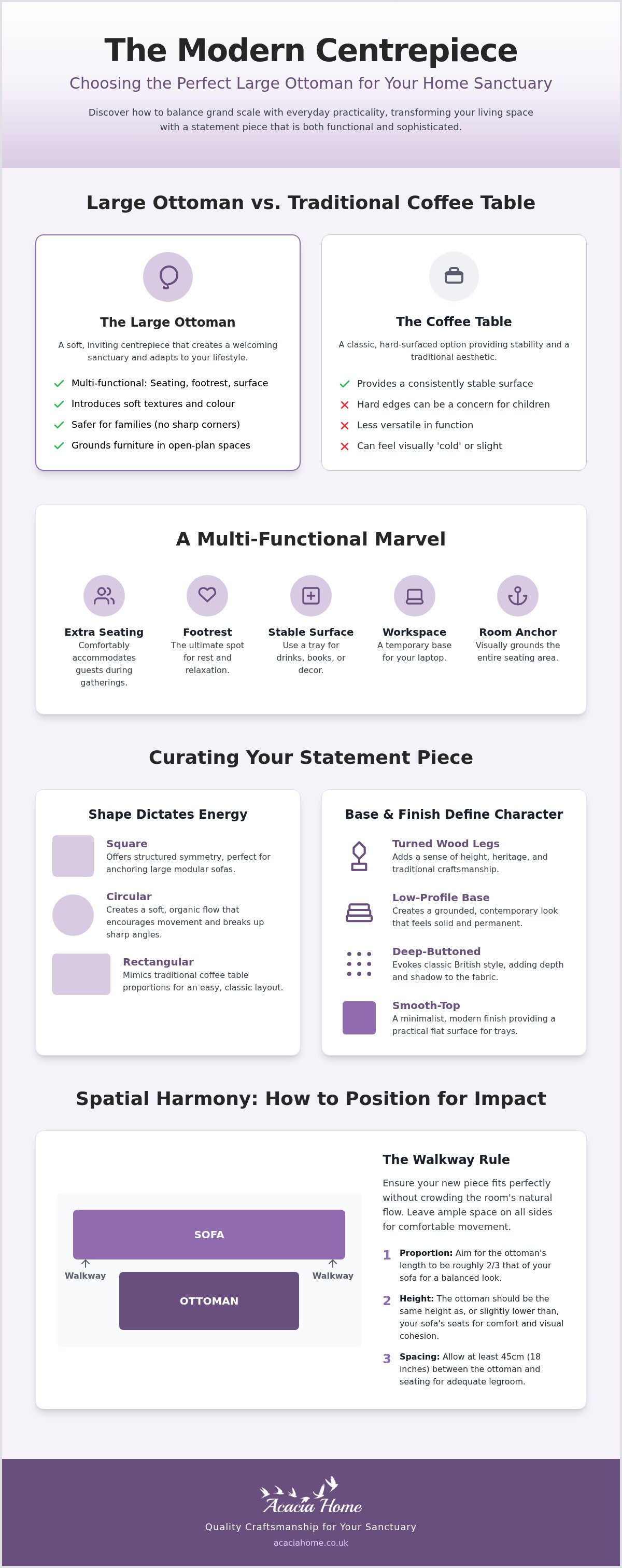
Shape dictates energy. A square design offers a sense of structured symmetry, perfect for anchoring a large modular sofa. Rectangular versions often mimic the proportions of a coffee table, making them an easy transition for those used to traditional layouts. If you’re looking to break up a room full of sharp angles, an oversized circular design provides a soft, organic flow that encourages movement. These choices are essential for achieving Spatial Harmony within your home. The base of the piece is equally influential. Traditional turned wood legs add a sense of heritage and height, whilst low-profile bases create a grounded, contemporary look that feels solid and permanent.
Finishing touches like deep-buttoning or smooth-top surfaces also play a significant role. Deep-buttoned designs evoke a sense of classic British craftsmanship, adding depth and shadow to the fabric. Conversely, a smooth-top finish feels minimalist and modern, providing a flatter surface that's often more practical for balancing trays.
Fabric Choices for the British Home
The textile you choose defines the "feel" of your sanctuary. Velvet remains a favourite for its deep colour saturation and luxurious sheen, bringing an upscale tastemaker's touch to any lounge. For those seeking a more relaxed, farmhouse, or coastal vibe, linen blends offer a breathable, lived-in aesthetic that feels effortlessly chic. If your home is a bustling hub of activity, leather or high-quality faux-leather provides a robust, easy-clean surface that ages beautifully. You might find inspiration in our curated range of footstools and ottomans, where each material is selected for its ability to balance beauty with the demands of a modern household.
The Importance of Internal Craftsmanship
Beauty must be more than skin deep. Since a large ottoman often doubles as secondary seating, a solid internal frame is non-negotiable. It provides the structural integrity needed to support guests without wobbling or creaking over time. Inside, the choice of padding matters. High-density foam ensures the piece retains its crisp silhouette and supportive "bounce" even after years of use. In contrast, fibre-fill offers a softer, more "sink-in" feel that requires occasional plumping. This commitment to craftsmanship reflects a blend of global heritage and British styling, ensuring your furniture remains a timeless part of your home’s story.
The Great Debate: Large Ottoman vs. Traditional Coffee Table
Deciding between a coffee table and a large ottoman is rarely just about aesthetics; it is a fundamental decision about how you intend to inhabit your space. A wooden or glass table provides a rigid, formal surface that excels at holding a tray of drinks or a collection of heavy art books. However, it can also feel somewhat cold and clinical in a room that is meant for unwinding. In contrast, an upholstered piece brings an immediate sense of warmth and tactile comfort, inviting you to literally put your feet up. This choice dictates the energy of your lounge, shifting it from a formal reception room to a cozy, lived-in sanctuary.
For those with young children, the choice often becomes a matter of peace of mind. The sharp corners of a traditional coffee table represent a constant hazard for toddlers finding their feet. A large ottoman removes this worry entirely, replacing hard edges with soft, padded surfaces. It becomes a safe island for play and a forgiving landing spot for inevitable tumbles. This transition from furniture as a hazard to furniture as a soft sanctuary is often the deciding factor for family-oriented homes where safety and comfort are paramount.
Uncertainty about where to place a glass of wine or a cup of tea is perhaps the most common hesitation when considering upholstery. The solution is the "tray trick." By placing a substantial, flat-bottomed tray on top of the fabric, you create a stable, hard surface for drinks whilst retaining the soft look of the piece. This duality allows you to enjoy the best of both worlds; you have practicality when you need it and uncompromised comfort when you don't. Maintenance requirements also differ significantly. Whilst wood requires regular polishing to avoid water rings, a fabric piece demands a different rhythm of care, such as light hoovering or the use of textile protectors to ensure longevity.
When to Choose an Ottoman
An ottoman is the ideal companion for informal family spaces where "feet-up" lounging is the primary activity. It is the perfect tool for adding warmth and texture to a room that feels "cold" due to an abundance of hard surfaces like tile or wood. If you frequently host social gatherings, its ability to serve as extra seating makes it a far more versatile investment than a static table.
When to Stick with a Coffee Table
A coffee table remains the preferred choice for formal entertaining where drinks and hors d'oeuvres are frequently served without the need for additional seating. It is better suited for showcasing delicate ornaments or heavy books that require a perfectly level, unyielding surface. For those committed to a very traditional or minimalist "hard" aesthetic, the clean lines of timber or metal may feel more appropriate than the volume of upholstery.
Spatial Harmony: How to Measure and Position for Impact
Achieving a sense of balance in your lounge is an art form that relies heavily on the relationship between your furniture's scale and the surrounding floor space. A large ottoman should never feel like an afterthought squeezed into a gap; it deserves to be the rhythmic centre of your seating arrangement. When positioned correctly, it acts as a soft island that anchors the room, drawing the eye and inviting family members to gather. In large L-shaped or U-shaped sectionals, these substantial pieces are particularly effective at filling the central "void," turning a sprawling sofa into a cohesive and intimate conversation pit.
To maintain a comfortable flow, you must adhere to the "Walkway Rule." This involves leaving approximately 40-50cm of clearance on all sides of the piece. This specific distance is the "sweet spot" of interior design. It's wide enough to allow for easy movement through the room without shimmying sideways, yet close enough that you can still reach your tea or book whilst remaining comfortably seated. By respecting these boundaries, you ensure that your furniture enhances the room's utility rather than obstructing its natural paths.
The Measuring Masterclass
Before you commit to a specific design, it's vital to ensure the proportions are correct for your sanctuary. Follow these three simple steps to guarantee a perfect fit:
Step 1: Measure the internal width of your sofa's seating area. Your ottoman should ideally be between half and two-thirds of this length to look balanced.
Step 2: Aim for a height that is within 2-5cm of your sofa seat. A piece that is significantly taller or shorter will feel disjointed and uncomfortable for resting your legs.
Step 3: Map out the footprint on your floor using masking tape. Leave it there for a day to see how the scale affects your daily movement and the room’s overall "feel."
Pairing with Other Seating
A well-curated room is a collection of harmonious relationships. Whilst the ottoman often pairs with a sofa, you should also consider how it interacts with your occasional chairs. To maintain a sophisticated look, try to keep a consistent formality register across all pieces. For instance, a deep-buttoned velvet ottoman pairs beautifully with traditional Louis-style chairs, whereas a low-profile linen design suits more modern, clean-lined tub chairs. Position your seating to encourage conversation flow, ensuring that every seat has a clear "line of sight" to the ottoman. This creates a social hub that feels intentional and warm.
If you're ready to find the centrepiece for your own sanctuary, browse our hand-picked collection of ottomans and footstools to discover a piece that reflects your personal style.
The Acacia Home Touch: Quality Craftsmanship for Your Sanctuary
At Acacia Home, we believe your living space is a living, breathing extension of your identity. It isn't just about filling a room with furniture; it's about curating a sanctuary that reflects your values and your journey. Every large ottoman in our collection is chosen with this philosophy in mind. We don't just look for items that fill a gap. We seek out pieces that add soul to a home. Our expert curation process involves a deep understanding of how a single piece can shift the energy of a room, turning a simple lounge into a place of genuine connection and rest.
We act as a bridge between skilled global manufacturers and the unique requirements of the British home. This global-to-local connection allows us to bring you world-class craftsmanship that still feels intimately connected to local traditions of quality. As a family-owned business, we take immense pride in the trade links we've established over years of dedicated service. This isn't just a transaction for us. It's a personal investment in your creative journey, backed by a commitment to traditional service that feels increasingly rare in the modern world.
A Sanctuary in Every Detail
We focus heavily on the sensory appeal of every item we select. The "feel" of a fabric or the way a piece impacts the atmosphere of a room is just as important as its physical dimensions. Our family roots mean we treat every customer like a guest in our own home, offering a level of care and guidance that larger retailers often overlook. To see how these principles apply across different styles, we invite you to explore the versatile ottoman in our comprehensive guide to multi-functional living.
Seamless Integration into Your Lifestyle
Your home is constantly evolving, and your furniture should be able to keep pace. We curate our collection to ensure that every large ottoman we offer possesses a timeless quality that transcends fleeting trends. Investing in high-quality accents means choosing pieces that will look just as beautiful in five years as they do today. These are the heirlooms of tomorrow, designed to adapt as your personal style grows and changes. There has never been a better time to transform your living space into the sanctuary you deserve. By choosing a piece that balances grand scale with everyday practicality, you aren't just buying furniture; you're making a statement about the life you want to lead.
Elevating Your Sanctuary with Purposeful Design
Choosing a large ottoman is about more than just filling a gap in your floor plan; it's about defining the spirit of your home. Throughout this guide, we've explored how these versatile anchors bridge the gap between luxury lounging and practical surface space, providing a safe and stylish alternative to the traditional coffee table. By mastering the nuances of scale and the "Walkway Rule," you can ensure your piece enhances the room's flow whilst serving as a soft, inviting focal point for family and guests alike.
At Acacia Home, we take great pride in our role as a family-owned British business. Every piece in our collection is expertly curated for style and comfort, ensuring that your furniture is a true reflection of your personal aesthetic and a testament to quality craftsmanship. With nationwide delivery across the UK, bringing a touch of refined, global-to-local design into your living room is a seamless experience.
Discover our curated collection of elegant large ottomans and take the first step toward transforming your lounge into a warm, welcoming retreat. Your sanctuary is waiting to be realised, and we're here to help you every step of the way.
Frequently Asked Questions
Can a large ottoman really replace a coffee table?
Absolutely, provided you use a sturdy tray to create a stable surface for drinks. Whilst a traditional table offers a rigid top, a large ottoman introduces a softer aesthetic that is often more inviting for family life. It successfully bridges the gap between a functional surface and a comfortable footrest, making it a superior choice for those who value a relaxed, sanctuary-like atmosphere in their lounge.
What is the best fabric for a large ottoman in a busy family home?
Leather or high-quality faux-leather are excellent choices due to their wipe-clean nature and ability to age gracefully. If you prefer the tactile warmth of fabric, look for high-performance synthetic blends or treated linens. These materials offer the sensory appeal of traditional upholstery whilst providing the durability needed to withstand the inevitable spills and heavy use of a bustling household.
How do I keep a large ottoman from sliding on wooden floors?
The most effective solution is to apply high-quality non-slip rubber pads to the bottom of the legs. Alternatively, positioning the piece on a large area rug provides enough friction to keep it grounded. This not only protects your floorboards from scratches but also ensures the piece remains a steady anchor for your seating arrangement, even when used as secondary seating for guests.
Is a square or rectangular large ottoman better for my room?
A square design is usually best for L-shaped or U-shaped sectionals, as it fits neatly into the central nook. If you have a traditional straight sofa, a rectangular version often mirrors the proportions more elegantly. Think about the flow of your room; a rectangular piece can help elongate a space, whilst a square one creates a more intimate, clustered feel for conversation.
How do I clean an upholstered ottoman if something spills?
Blot the spill immediately with a clean, dry cloth to absorb as much liquid as possible; never rub, as this pushes the stain deeper into the fibres. Use a small amount of distilled water and a mild, fabric-safe detergent for any remaining marks. For delicate materials like velvet, it's always wise to test a small, inconspicuous area first to ensure the colour isn't affected.
Should my ottoman match my sofa exactly in colour and fabric?
Not necessarily, as introducing a contrasting texture or colour can add a sophisticated layer of depth to your room. Whilst matching creates a seamless, minimalist look, choosing a complementary shade allows the piece to stand out as a curated statement. It's an opportunity to express your personal identity by mixing materials, such as pairing a leather sofa with a textured fabric piece.
What tray size should I use on a large ottoman?
Aim for a tray that covers approximately one-third to one-half of the surface area. This ensures you have enough stable space for several drinks or a teapot whilst still leaving plenty of soft upholstery visible for resting your feet. A tray that is too large can overwhelm the piece, making it feel more like a hard table than a comfortable, versatile accent.
Can I use a large ottoman in a bedroom as well as a living room?
A large ottoman is a wonderful addition to a bedroom, particularly when placed at the foot of the bed. It provides a convenient spot for dressing or laying out clothes, whilst adding a sense of boutique hotel luxury to your private sanctuary. This versatility allows the piece to evolve with your home, moving between rooms as your styling needs and lifestyle change over time.


Comments