
Adding a Chaise to a Living Room: The Ultimate Styling Guide
What if the most impactful change you could make to your home wasn't a total renovation, but the addition of a single, sculptural piece? Many homeowners find themselves caught in a cycle of adding bulky armchairs or oversized sofas, yet they still feel their space lacks that curated, "expensive" finish. It's a common worry that adding a chaise to a living room might disrupt the flow of the house or feel like an indulgence you can't quite justify. We understand that hesitation; after all, your home is a sanctuary that needs to function as beautifully as it looks.
We're here to show you that a chaise longue is far more than just a place to lounge. In this guide, you'll discover how to master the art of placement, ensuring your new addition enhances rather than hinders your room's natural movement. We'll explore the sensory delight of choosing the right fabrics, from tactile linens to rich velvets, whilst providing expert tips on creating a multifunctional seating arrangement. From carving out a sun-drenched reading nook to zoning an open-plan area with architectural elegance, you're about to learn how to transform your living space into a truly personal statement.
Table of Contents
The Allure of the Chaise Longue: Defining Your Space
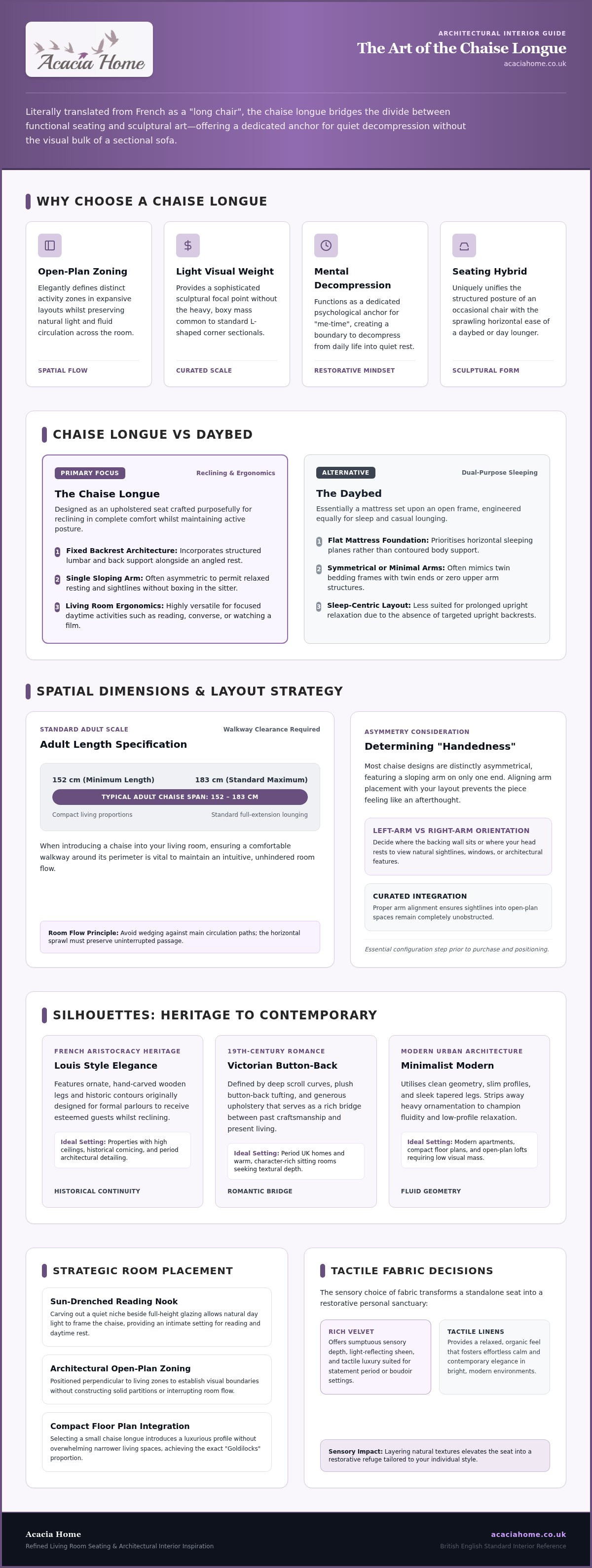
A chaise longue, literally translated from French as a "long chair," is an upholstered seat designed for reclining in complete comfort. Unlike standard sofas, it invites a specific type of relaxation that is both personal and indulgent. Adding a chaise to a living room isn't just about extra seating; it's about making a clear statement of intent. It signals that your home is a place where rest is a priority. In the fast-paced nature of modern life, having a dedicated spot for "me-time" offers profound psychological benefits. It acts as a mental anchor for decompression, allowing you to transition from the chaos of the day into a state of quiet reflection within your own sanctuary.
Whilst occasional chairs are perfect for short-term socialising or filling a quiet corner, the chaise serves a deeper, more permanent purpose. It combines the structured support of a high-end chair with the expansive sprawl of a bed. This unique hybrid makes it a timeless symbol of sophisticated British interior design, bridging the gap between functional furniture and sculptural art. It's a piece that demands you slow down, making it the ultimate addition for those who view their home as a personal statement of style and comfort.
Historical Elegance Meets Modern Living
The origins of the chaise longue date back to ancient civilisations, but it was the French aristocracy who truly refined it into a social statement. Historically, these pieces were found in formal parlours, used by the elite to receive guests whilst reclining in style. Today, modern silhouettes have adapted beautifully to our contemporary UK open-plan homes. They've transitioned from stiff, formal relics into soft, inviting pieces that anchor a multifunctional lounge. This evolution allows you to bring a sense of global heritage into your space whilst maintaining a look that is both fresh and contemporary.
Chaise vs. Daybed: Understanding the Difference
It's easy to confuse a chaise with a daybed, but their structural differences are distinct and impact how you'll use them. A chaise typically features a fixed backrest and often a single, sloping arm, whereas a daybed is essentially a mattress on a frame, designed for sleeping as much as sitting. For a living room, the chaise is usually the more versatile choice because it offers the ergonomic support needed for reading or watching a film. When choosing your piece, consider the scale carefully. Standard adult chaises range between 152 to 183 cm in length, so you'll want to ensure your layout permits a comfortable walkway around it to maintain a natural flow.
Selecting the Perfect Silhouette for Your Interior
Choosing a silhouette is about more than just picking a seat you like. It's about finding a form that speaks to the architectural language of your home. If you live in a property with high ceilings and original cornicing, a piece with ornate, carved legs inspired by Louis style chairs creates a sense of historical continuity. Conversely, a minimalist frame with sleek, tapered legs suits the clean geometry of a modern apartment. Understanding the historical evolution of reclining chairs helps us see how these shapes have shifted from the rigid daybeds of the 18th century to the fluid, ergonomic forms we adore today.
A vital but often overlooked detail when adding a chaise to a living room is its "handedness." Most designs are asymmetrical, featuring an arm at only one end. You must decide whether a left-arm or right-arm configuration best suits your layout. Think about where the wall sits or where you want to rest your head to enjoy the view. Getting this right ensures the piece feels integrated rather than like an afterthought. It's these small, considered choices that elevate a room from a collection of furniture to a curated home.
Traditional vs. Contemporary Silhouettes
Victorian-style chaises, with their button-back detailing and deep scrolls, bring a romantic, heritage feel to period properties. They act as a beautiful bridge between the past and present. If you're working with a more compact floor plan, don't feel you have to compromise on elegance. Utilising a small chaise longue allows you to introduce that same sophisticated profile without overwhelming a smaller room. It's about finding that "Goldilocks" fit that feels just right for your specific space whilst adding a chaise to a living room.
Fabric and Texture: A Sensory Decision
The fabric you choose is the final layer of your home's sanctuary. Velvet remains a favourite for its deep, light-catching qualities and unmatched softness. It's perfect for creating a dramatic focal point in plum or olive tones. For those who prefer a more relaxed, British cottage aesthetic, linen and cotton blends offer a breathable, tactile experience. Don't let the fear of maintenance hold you back. Many high-quality performance fabrics now offer the look of luxury with the durability needed for busy family life. If you're ready to explore these textures in person, you can browse our curated range of fabrics to find your perfect match.
Strategic Placement: Where to Position Your Chaise
In open-plan UK homes, defining distinct areas without building physical walls is a subtle art. Adding a chaise to a living room provides a low-profile boundary that separates the lounge from the dining or kitchen area whilst keeping the sightlines clear. To maintain a sense of high-end curation, you must allow for "breathing room" around your furniture. Professional standards suggest leaving a minimum clearance of 76 to 91 cm for primary walkways around the piece. This prevents the room from feeling cramped and ensures the chaise remains a standalone piece of art rather than a hurdle to be stepped over.
Consider what sits alongside your seating. Traditional coffee tables can sometimes feel too rigid or heavy next to the fluid lines of a reclining seat. Instead, pairing your piece with a versatile ottoman offers a softer, more multifunctional alternative. It provides a stable surface for a tray of tea whilst doubling as extra seating when you're entertaining guests. This strategic placement is essential when adding a chaise to a living room to ensure the space remains airy and intentional.
The Window Seat: Harnessing Natural Light
Positioning your chaise within a bay window creates the quintessential British reading nook. It's a space where you can bathe in natural light whilst staying sheltered from the elements. When planning this placement, consider the back height of the piece. You want a silhouette that nestles under the windowsill rather than obstructing your view of the garden. Given the history of the chaise longue as a seat for leisure, it makes sense to place it where the scenery is best. Be sure to select light-fast fabrics, such as performance linens, to protect against sun-bleaching over the coming seasons.
Fireside and Corner Placements
A fireplace is the natural heart of many UK homes, yet balancing its visual weight can be tricky. A slender chaise placed at an angle to the hearth creates an intimate conversation area that feels warmer and more inviting than a standard armchair. If you're dealing with a particularly "boxy" room, placing your chaise in a corner can soften the sharp angles and add a sense of organic flow. This approach allows you to:
Create a focal point that draws the eye without dominating the floor space.
Utilise awkward niches that are too small for a sofa but too large for a lamp table.
Maintain an absolute minimum clearance of 45 to 61 cm for secondary pass-throughs to keep the room functional.
The Art of Styling: Textures, Colours, and Accents
Styling is where your personality truly shines through. When adding a chaise to a living room, you are faced with a choice: do you want this piece to whisper or to shout? A chaise can act as a quiet, harmonious extension of your existing sofa, or it can serve as a bold, architectural anchor that commands the eye. To achieve a curated, professional finish, you must look beyond the furniture itself and consider the sensory layers of textures, light, and colour that surround it. This is about more than just aesthetics; it is about creating an atmosphere that feels both intentional and deeply personal.
Think about the "vignette" you are creating. A chaise should never sit in isolation. It needs a supporting cast of characters to make it a functional destination. This might include a slender floor lamp for evening reading or a small, hand-crafted side table to hold a favourite book. By carefully selecting these accents, you transform a simple seat into a lived-in sanctuary. Lighting plays a crucial role here. A warm-toned bulb in a wall sconce or a directional lamp can highlight the rich texture of your chosen fabric, making the space feel inviting even after the sun has set.
Mastering Colour Contrast
If your living space is predominantly neutral, a chaise in a rich jewel tone like emerald green or deep navy can ground the entire room. This approach gives the space a sense of heritage and weight. For a more serene, sophisticated atmosphere, try tone-on-tone styling. This involves selecting a fabric just a few shades lighter or darker than your walls. To ensure the piece feels integrated, tie the colour into your existing curtains or the subtle flecks of a rug. This creates a rhythmic flow that guides the eye naturally through the room whilst adding a chaise to a living room.
Accessorising for Comfort and Style
Layering is the secret to that "expensive" look often found in boutique hotels. Start with cushions. Whilst square accents are traditional, a bolster cushion at the head of the chaise provides a classic, structured silhouette that mirrors the piece's history. Next, consider the "drape" of a throw. Instead of folding it neatly, try a casual, asymmetrical toss across the foot of the seat. This achieves a soft, inviting look that says the room is enjoyed rather than just looked at. If you are looking for more inspiration on how to elevate your space, you can view our latest collection of occasional furniture to find the perfect finishing touches.
Standalone Elegance: Why a Dedicated Chaise Outshines the Sectional
Whilst many homeowners gravitate towards large sectional sofas for their perceived practicality, there is a distinct, understated power in the standalone chaise longue. Unlike a sectional, which often dictates the entire layout of a room, adding a chaise to a living room as a dedicated piece offers a level of flexibility that fixed furniture simply cannot match. It's the difference between a piece that serves as a functional anchor and one that acts as a curated work of art. A standalone chaise provides a visual lightness, as its low profile and often single-arm design allow light and energy to flow through the space rather than being blocked by a heavy, high-backed corner unit.
Choosing a dedicated piece is also an investment in personal luxury. It feels like a special treat; a seat designed specifically for the individual's comfort rather than just another section of the family sofa. This occasional nature gives the chaise a unique character, positioning it as a place for quiet contemplation or a restorative afternoon nap. It's this sense of purpose that transforms a house into a sanctuary, reflecting a lifestyle that values quality and personal space over mere volume.
Flexibility for Future Home Moves
One of the most practical benefits of a standalone chaise is its ability to adapt. Sectional sofas are notoriously difficult to transition between homes; a configuration that fits a left-hand corner in one property may become a cumbersome obstacle in the next. A standalone piece, however, is a versatile companion that can be easily re-positioned to suit new architectural features or room shapes. Over time, as your aesthetic evolves, the ease of re-upholstering a single, well-crafted chaise allows you to refresh your decor without the significant expense of replacing a whole modular suite. These pieces are built with a sense of heritage, designed to become future heirlooms that move with you through every chapter of life.
Creating a Balanced Room Composition
Many living spaces fall into the "L-shape trap," where a massive sectional swallows the floor plan and makes the room feel smaller and more enclosed. By adding a chaise to a living room as a standalone element, you encourage a more open and balanced composition. This arrangement naturally promotes a better conversation flow, as it allows for a more circular grouping of furniture rather than a rigid, one-directional setup. Ultimately, curating your home with standalone pieces is about more than just interior design; it's an act of self-expression. It allows you to create a space that's as unique and multi-layered as your own personality, ensuring your home remains a true reflection of your identity.
Transform Your Home Into a Curated Sanctuary
Choosing to elevate your space is an act of personal expression that goes beyond mere furniture selection. By adding a chaise to a living room, you aren't just gaining a seat; you're creating a structural anchor that defines your home's flow and character. We've explored how these standalone pieces offer a visual lightness that heavy sectionals simply cannot provide, whilst serving as a dedicated haven for your quietest moments. Whether you're drawn to the heritage of a Louis style frame or the contemporary appeal of tactile linens, the right chaise becomes a timeless investment in your own well-being.
As a family-owned British business, we take immense pride in being specialists in occasional seating. Our passion lies in bridging the gap between expertly sourced global craftsmanship and the unique needs of your local home. We invite you to explore our curated collection of elegant chaise longues and discover the piece that speaks to your aesthetic. Your journey toward a more sophisticated, restful living space begins with a single, beautiful choice.
Frequently Asked Questions
Is a chaise longue comfortable enough for everyday use?
Yes, these pieces are designed specifically for ergonomic reclining and total comfort. They offer full leg support and a structured back that is perfect for long-term use. Unlike occasional chairs meant for upright sitting, a high-quality chaise is a sanctuary for daily relaxation. Our expertly sourced designs ensure they withstand the rigours of daily life whilst providing a sensory retreat for reading or resting in your favourite corner.
Can I add a chaise longue to a very small living room?
Absolutely, choosing a compact silhouette is key for smaller spaces. A smaller model can often fit into awkward niches or beside a hearth where a full sofa would simply overwhelm the floor plan. Adding a chaise to a living room with limited space actually provides a sense of visual lightness. Its low profile prevents the area from feeling boxed in, making your home appear more expansive and intentionally curated.
Which side should the arm of the chaise longue be on?
This decision depends entirely on your room's layout and natural traffic flow. You should position the arm on the side that doesn't block your line of sight or a main walkway. If you plan to place it against a wall, ensure the arm is on the open side to create an inviting entry point. Consider where you'll rest your head to best enjoy the fireplace or a sun-drenched window view.
How do I clean and maintain a velvet chaise longue?
Regular maintenance is the secret to keeping velvet looking its best for years. We recommend vacuuming the fabric weekly using a soft brush attachment to prevent dust from settling into the pile. If a spill occurs, blot the area immediately with a clean, dry cloth. For deeper cleaning, always consult a professional; however, a gentle steam can often revive the fabric's natural lustre and remove any minor pressure marks.
What is the best way to arrange a chaise with a standard sofa?
Positioning your chaise at a right angle to your sofa creates an intimate and inclusive conversation zone. This arrangement avoids the heavy look of a traditional L-shaped sectional whilst maintaining a social atmosphere. Ensure there is a gap of at least 45 cm between the pieces to allow for comfortable legroom and ease of movement. This balanced composition encourages a natural flow that feels both intentional and sophisticated in any home.
Does a chaise longue need to match my other furniture exactly?
It doesn't need to be an identical match; in fact, a contrasting piece often adds more character to a room. You can tie the chaise into your existing scheme by selecting a fabric that shares a similar undertone or by using coordinating cushions. Mixing a modern chaise with traditional Louis style chairs creates a beautiful, multi-layered look that reflects a worldly and expert eye for the craft of interior design.
Are chaise longues out of style in 2026?
They remain a timeless staple of sophisticated British interiors and are very much in style. In 2026, the trend has shifted away from rigid, modular sets towards standalone pieces that offer flexibility and sculptural beauty. A dedicated chaise is a visionary choice for the modern home, acting as a functional focal point that prioritises personal comfort and architectural elegance over mass-produced, uniform furniture arrangements that can feel cold and impersonal.
What is the ideal length for a living room chaise?
Most standard adult chaises range between 152 and 183 cm in length. When adding a chaise to a living room, you must ensure it fits your height comfortably whilst leaving enough clearance for walkways. For smaller apartments, a more compact version around 140 cm provides the same aesthetic impact without dominating the floor space. Always measure your intended spot twice to ensure a perfect, unhurried fit that respects your home's flow.


Comments